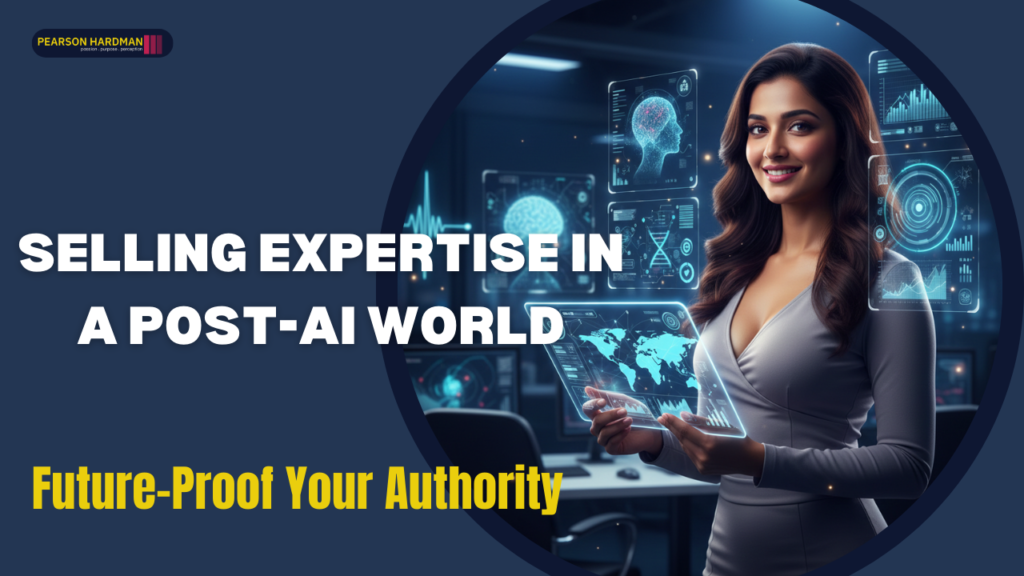
The professional landscape has shifted beneath our feet so rapidly that many consultants and coaches are still checking their compasses while the territory itself has been completely redrawn. We have officially entered an era where the raw commoditization of information is complete, leaving those who rely on “knowing things” in a very precarious position. If a large language model can draft a legal brief, diagnose a standard medical condition, or write a marketing plan in seconds, the traditional value proposition of the professional service provider has vanished. This evolution is the core of what we call the rise of the high-value advisor, a transition where success depends entirely on Selling Expertise in a Post-AI World by offering what machines cannot: context, judgment, and deep emotional resonance. In this article, you will learn how to move beyond being a mere repository of facts and transform into a strategic partner who is indispensable to your clients’ most complex challenges.
The problem facing many legacy consultants is that they are still trying to sell the “what” and the “how” in a market that can get those answers for free from a chatbot. Consequently, the only path to premium pricing and long-term sustainability is to focus on the “who” and the “why” of the advisory relationship. As we navigate this complex landscape, it becomes clear that Selling Expertise in a Post-AI World is less about technical proficiency and more about the synthesis of human intuition with digital speed. You are no longer competing with other humans alone; you are competing with the illusion of infinite, free knowledge. In the following sections, we will explore the nuances of building an unshakeable personal brand, the psychological triggers of high-ticket consulting, and the specific strategies you need to implement to ensure your expertise remains a high-value asset in 2026 and beyond.
The Death of Information Scarcity and the Birth of Wisdom Premiums
For decades, the business of consulting was built on the foundation of information scarcity, where an expert was paid simply because they had access to data or specialized knowledge that the client did not. However, as we focus on Selling Expertise in a Post-AI World, we must acknowledge that information is now the most abundant resource on the planet, which has effectively driven its market price toward zero. This doesn’t mean that expertise is dead, but it does mean that the location of value has shifted significantly from the data itself to the interpretation and application of that data. The modern high-value advisor is not a human encyclopedia but a filter who helps clients navigate the overwhelming noise of the digital age to find the specific signal that will drive their business forward. Similarly, the ability to provide a “Wisdom Premium” is now the primary differentiator for those who are successful in the modern marketplace.
When you are engaging in the process of Selling Expertise in a Post-AI World, your primary goal is to provide a level of strategic judgment that an algorithm cannot replicate. AI is excellent at identifying patterns in historical data, but it lacks the “human-in-the-loop” intuition required to navigate unprecedented cultural shifts or highly nuanced interpersonal dynamics. For example, a marketing AI can suggest a thousand taglines, but a high-value advisor knows which one will resonate with a specific board of directors or a fragile customer demographic during a crisis. This shift toward wisdom-based service delivery requires a complete overhaul of your marketing message, moving away from “I know how to do this” toward “I know what this means for your specific future.” By framing your services as a safeguard against the errors of unguided automation, you establish a position of authority that commands respect and premium compensation.
Building a Personal Brand that Algorithms Cannot Replicate
In the current professional climate, your technical skills are essentially the “ante” to get into the game, but your personal brand is the only thing that allows you to win it. As we explore the best methods for Selling Expertise in a Post-AI World, it becomes evident that clients are no longer just buying a solution; they are buying a relationship and a specific worldview. A personal brand built on transparency, unique life experiences, and radical honesty creates a “moat” around your business that no AI can cross. While an algorithm can mimic your writing style, it cannot mimic your scars, your failures, or the specific “gut feelings” you have developed over twenty years in the trenches. Therefore, the most successful advisors in 2026 are those who lean into their humanity rather than trying to appear as polished and “perfect” as a machine.
This human-centric branding is essential for Selling Expertise in a Post-AI World because trust has become the rarest currency in the global economy. As deepfakes and AI-generated content saturate every corner of the internet, consumers and B2B buyers are becoming hyper-skeptical of anything that feels too smooth or too generic. To stand out, you must cultivate a “signature voice” that is unmistakably yours, using real-world stories and contrarian insights to prove that there is a real person behind the screen. This might involve sharing the behind-the-scenes reality of your consulting practice or taking a public stand on controversial industry trends that an AI would be programmed to avoid. By being a “High-Value Human,” you create an emotional connection with your audience that makes the idea of replacing you with a software subscription feel like a significant downgrade in quality and security.
The Power of Cognitive Empathy in Strategic Consulting
One of the most critical components of Selling Expertise in a Post-AI World is the application of cognitive empathy, which is the ability to understand a client’s internal state and decision-making process at a profound level. AI can simulate empathy through sentiment analysis, but it cannot truly feel the weight of a CEO’s responsibility or the fear of a founder losing their life’s work. When you operate as a high-value advisor, your value lies in your ability to sit across from a client and sense the unsaid tensions in the room. You are looking for the subtext, the hidden agendas, and the emotional blockages that prevent a team from executing a brilliant plan. This level of insight is where the real money is made in the modern economy, as it solves the “human problems” that technology often creates or ignores.
Furthermore, Selling Expertise in a Post-AI World requires you to act as a psychological anchor for your clients during times of rapid change. As the pace of technological disruption accelerates, leaders are feeling more overwhelmed and isolated than ever before. Your role is to provide the steady hand and the calm perspective that comes from having seen similar cycles in the past. You are selling “certainty in an uncertain age,” which is a product that no algorithm can ever fully provide. By focusing on the emotional and psychological outcomes of your work, you move your services from the “disposable” category to the “essential” category. You become the person the client calls not because they need a task done, but because they need to know they are making the right choice for their people and their legacy.
Pricing for Outcomes Instead of Hours: The New Monetization Model
The traditional model of billing by the hour is perhaps the greatest obstacle to successfully Selling Expertise in a Post-AI World. In an era where AI can do a “ten-hour task” in ten seconds, tying your income to your time is a recipe for financial disaster. High-value advisors must pivot to value-based or outcome-based pricing models, where the fee is determined by the impact of the solution rather than the duration of the labor. This requires a fundamental shift in how you conduct sales conversations, focusing on the “Value of the Problem” rather than the “Price of the Process.” If you can save a company five million dollars in potential losses through a single hour of strategic consultation, that hour is worth hundreds of thousands of dollars, regardless of how “easy” it was for you to provide the answer.
Implementing this model is a cornerstone of Selling Expertise in a Post-AI World because it aligns your incentives with the client’s success. It moves you away from being a “vendor” who is a cost center and transforms you into a “partner” who is a profit generator. To do this effectively, you must develop the skill of “value discovery,” asking deep questions to uncover the true financial and emotional cost of the client’s current pain points. Once the client recognizes the massive stakes involved, your fee becomes a small fraction of the value you are creating or the risk you are mitigating. This is the only way to maintain high margins in a world where “doing the work” is becoming increasingly automated. You are being paid for your “judgment calls,” and in 2026, a single correct judgment call is worth more than a thousand hours of manual labor.
High-Ticket Consulting in the Age of Automation
When we talk about Selling Expertise in a Post-AI World, we are often talking about the high-ticket space where the complexities are too great for simple automated solutions. High-ticket consulting thrives on the “bespoke” nature of the engagement, where every recommendation is tailored specifically to the unique DNA of the client’s organization. Automation works best on standardized problems, but high-value problems are almost never standardized; they are messy, political, and deeply rooted in specific historical contexts. Your ability to navigate these “messy” environments is your greatest asset. You should market your services as the “anti-algorithm,” providing a level of customization and nuance that is impossible for a scalable software platform to achieve at a lower price point.
To justify these high-ticket fees while Selling Expertise in a Post-AI World, you must provide an experience that feels premium at every touchpoint. This includes the way you communicate, the depth of your research, and the exclusivity of your access. High-value clients are looking for a “vetted” perspective they can trust implicitly, which means your reputation and your network are more important than your specific deliverables. By positioning yourself as a “selective” advisor who only takes on a few high-impact projects per year, you increase your perceived value and create a “waitlist effect.” This scarcity, combined with your demonstrated results, allows you to command fees that are completely decoupled from the hourly rates of the general market.
Content Strategy for the Modern Authority: Beyond the AI Echo Chamber
One of the greatest challenges in Selling Expertise in a Post-AI World is cutting through the massive amount of AI-generated content that is flooding social media and search engines. If you want to be seen as a high-value authority, you cannot simply produce “helpful tips” that look like they were written by a GPT model. Your content strategy must be built on “Original Insight” and “Proprietary Data.” This means sharing your own case studies, your own frameworks, and your own unique observations that cannot be found in a training manual. High-value advisors in 2026 use content to “disqualify” the wrong clients and “magnetize” the right ones, being bold enough to voice opinions that might be unpopular but are undeniably true in their experience.
When you are Selling Expertise in a Post-AI World, your content should act as a demonstration of your thinking process. Clients aren’t just looking for the answer; they are looking to see how you get to the answer. By “thinking in public,” you allow potential clients to experience your strategic mind before they ever sign a contract. This reduces the risk of the purchase and shortens the sales cycle significantly. Use long-form essays, deep-dive podcasts, and live Q&A sessions to show the depth of your expertise. Avoid the “listicle” format and instead opt for narrative-driven pieces that explore the complexities of your industry. This approach signals to the market that you are a “Category of One,” someone whose perspective is so unique that it simply cannot be automated or replaced by a cheaper alternative.
Global Trust and the Role of Transparency in Advisory Services
In the digital industrial revolution of 2026, transparency is no longer an optional ethical choice; it is a mandatory marketing strategy. Successfully Selling Expertise in a Post-AI World requires you to be radical about what you can do, what you cannot do, and how you use technology in your own process. If you use AI to assist in your research or data analysis, tell your clients. Explain how the combination of “Machine Speed” and “Human Oversight” gives them a better result than either one could achieve alone. This honesty builds a level of trust that is incredibly rare in a world of digital smoke and mirrors. By being the most transparent person in the room, you automatically become the most trusted, which is the ultimate competitive advantage for an advisor.
Furthermore, Selling Expertise in a Post-AI World on a global scale means understanding the cultural nuances of trust across different regions. What works in a New York boardroom might not work in a tech hub in Singapore or a manufacturing center in Germany. A high-value advisor knows how to adapt their “trust-building” style to the local context, demonstrating a level of cultural intelligence that is far beyond the capabilities of current AI models. This global adaptability ensures that your expertise remains portable and valuable, regardless of geographical boundaries. You are not just selling a service; you are selling a “Universal Standard of Excellence” that is backed by your personal integrity and your global track record of success.
Navigating the Complexities of a High-Value Sales Funnel
The sales funnel for a high-value advisor is significantly different from a traditional e-commerce or lead-gen funnel. When you are Selling Expertise in a Post-AI World, the funnel is not about “conversion rates” but about “relationship depth.” You are looking for high-quality interactions rather than high-volume clicks. This often involves a “slow-burn” approach where you nurture potential clients through consistent value and thoughtful outreach over months or even years. The goal is to be the “Only Logical Choice” when the client finally encounters a problem that is too big for them to solve on their own. This requires a level of patience and persistence that most automated marketing systems simply cannot maintain.
To master the high-ticket funnel while Selling Expertise in a Post-AI World, you should focus on “high-friction” entry points. This might sound counterintuitive in a world of “one-click” everything, but for high-value advisory, friction is a good thing. Asking a potential client to fill out a detailed application or have a preliminary “fit” call ensures that you are only talking to people who are serious about their growth and respect your time. This “exclusivity” is a powerful psychological trigger that reinforces your status as a high-value authority. It tells the client that you are a scarce resource and that your expertise is not something that can be bought by just anyone with a credit card. By protecting your boundaries, you increase the value of the access you eventually provide.
Marketing Expertise as a Strategic Data Asset
In 2026, one of the most innovative ways of Selling Expertise in a Post-AI World is to treat your collective wisdom as a “Data Asset” for your clients. This goes beyond simple advice and moves into the realm of providing proprietary benchmarks, trend forecasts, and strategic frameworks that the client can integrate into their own decision-making systems. You are essentially selling “Decision-Support Intelligence” that is fueled by your years of experience but delivered in a modern, data-rich format. This turns your expertise into a tangible product that has a clear ROI, making it much easier for a CFO to approve your high-level engagement fees.
To effectively sell this data-driven value, your marketing should focus on the “Actionable Outcomes” your intelligence enables. Instead of saying “I provide consulting,” say “I provide the proprietary framework that has helped ten companies in your sector reduce operational risk by 30%.” This specificity is the key to Selling Expertise in a Post-AI World, as it moves the conversation away from the “intangible” and toward the “verifiable.” You are providing a strategic edge that is backed by real-world evidence, which is exactly what sophisticated buyers are looking for in an increasingly competitive global market. By highlighting the strategic value of your “Human Data,” you elevate your brand to the level of a vital contributor to your client’s long-term digital transformation journey.
The Future of the Advisory Relationship: Beyond the Sale
As we look toward the end of the decade, the relationship between an advisor and their client will continue to become more integrated and collaborative. Selling Expertise in a Post-AI World is leading us toward a “Circular Advisory” model, where the expert and the client work in a constant feedback loop to refine and improve the performance of the organization. This means that the initial sale is truly just the beginning of a multi-year partnership, and your marketing must reflect this commitment to “Lifelong Value.” Brands that thrive will be those that view their clients’ challenges as their own and use their unique human perspective to help them navigate the ever-changing global market.
The successful advisor of 2026 is one who can bridge the gap between technical excellence and human business strategy. By focusing on Selling Expertise in a Post-AI World, you are positioning yourself at the center of the most significant professional shift of our time. You are selling the tools of judgment, the clarity of vision, and the security of a trusted partnership. It is a journey that requires constant innovation, radical transparency, and a relentless focus on the success of your global partners. As you move forward, remember that your humanity is your greatest asset, and in a world of data and automation, your personal promise is the most valuable thing you have to offer.
Conclusion: Mastering the Art of Human Insight
The journey toward mastering Selling Expertise in a Post-AI World is a continuous process of evolution that requires you to be as agile and intelligent as the technologies you use. We have seen that the key to success in 2026 lies in the ability to transform your complex technical data into a compelling human story of reliability, efficiency, and trust. By shifting your focus from the “what” to the “why,” you unlock a level of value that goes far beyond the digital world. You are not just providing advice; you are providing the foundation of a global economy that is faster, smarter, and more human than ever before.
As you implement these strategies, keep in mind that the most important part of expertise is the person who stands behind it. While the technology is incredible, the trust is built through the relationships you forge and the commitment you show to your clients’ long-term growth. The world of Selling Expertise in a Post-AI World is waiting for those who are brave enough to lead with transparency and smart enough to lead with data. The future of the high-value advisor is here, and it is more human than we ever imagined. It is time to step into the light of the fourth industrial revolution and show the world what your expertise is truly capable of achieving.