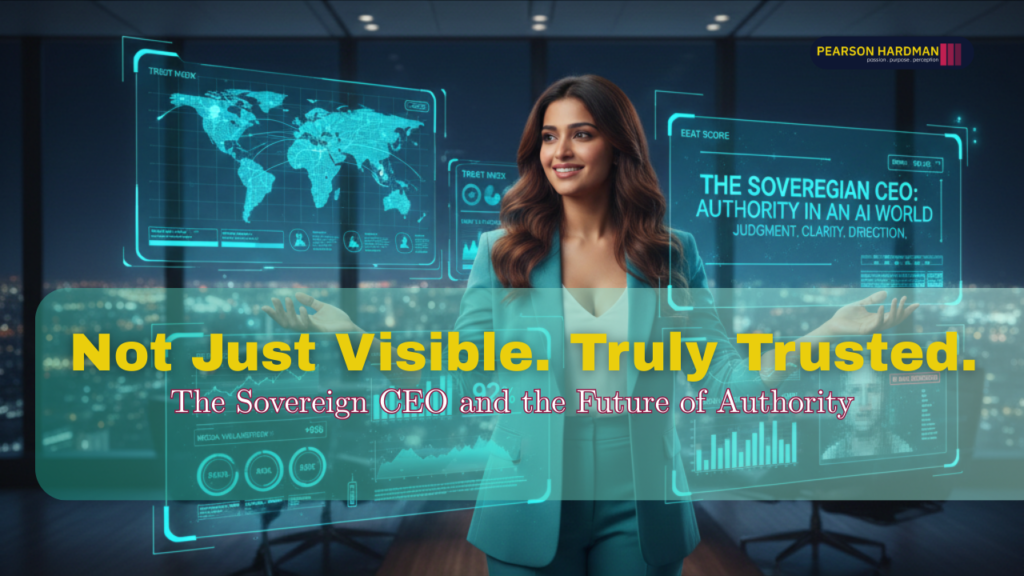
In 2026, leadership visibility is no longer optional, but credibility is becoming rare. Artificial intelligence has flattened content creation. Everyone can publish. Everyone can sound confident. Everyone can claim expertise. Yet very few leaders are actually trusted.
This gap between visibility and trust is where the concept of the Sovereign CEO becomes critical.
A Sovereign CEO is not defined by how often they appear online, but by how consistently their presence signals authority. Their ideas carry weight because they are grounded in experience, responsibility, and long-term decision making. In a world where AI can replicate tone and language, it still cannot replicate judgment. And judgment is the true currency of leadership.
Most founders and CXOs underestimate this shift. They believe personal branding is about frequency, virality, or polished content. In reality, it is about intellectual ownership. A Sovereign CEO owns a point of view that cannot be outsourced, automated, or copied.
Why Authority Is the New Differentiator, Not Attention
For the last decade, digital growth rewarded those who captured attention. Algorithms favoured volume. Platforms rewarded speed. But the rules are changing fast.
Search engines, investors, journalists, and enterprise buyers are now filtering aggressively. They are not asking who speaks the loudest. They are asking who understands the problem deeply.
AI has accelerated this shift. When everyone can generate content, content itself loses value. What gains value instead is context. Perspective. Experience. Consequence.
A Sovereign CEO does not comment on everything. They speak only where they have earned the right to speak. This restraint is what creates authority. Silence, when strategic, is more powerful than noise.
This is why seasoned leaders often appear calm, measured, and deliberate in their communication. They are not trying to impress. They are trying to clarify.
Why AI Cannot Replace a Human Leadership Brand
AI can simulate intelligence, but it cannot simulate accountability. A CEO’s personal brand is built on decisions that carried risk, moments that demanded courage, and outcomes that had real consequences.
When a leader speaks about scaling a company, people subconsciously ask one question. Have you done this yourself?
AI can summarise case studies. It cannot live through them. It cannot fail publicly. It cannot take responsibility for people, capital, or reputation.
That is why audiences instinctively trust leaders who share first-principle thinking rather than trend commentary. A Sovereign CEO builds credibility by explaining why a decision was made, not just what worked.
This distinction matters deeply for EEAT, media trust, and long-term brand equity.
The Strategic Value of a Sovereign CEO Brand
From a business perspective, CEO authority is not a soft metric. It has direct commercial impact.
Enterprise sales cycles shorten when decision makers recognise and trust the leadership behind the brand. Media coverage improves when journalists know exactly whom to quote. Investor confidence strengthens when founders articulate strategy with clarity rather than ambition alone.
At a market level, especially in India’s evolving business ecosystem, leadership visibility is becoming a competitive advantage. Founders from Pune, Mumbai, Bangalore, and Delhi are no longer competing only locally. They are competing globally for capital, partnerships, and attention.
A Sovereign CEO brand signals stability. It reassures stakeholders that the organisation is not dependent on trends, tools, or personalities that may disappear tomorrow.
Sovereignty Is Built Through Thought, Not Performance
One of the biggest mistakes modern leaders make is confusing performance with positioning. Constant posting, polished visuals, and motivational language may create visibility, but they do not create trust.
Trust is built when a leader demonstrates thinking depth. When they articulate trade-offs. When they acknowledge uncertainty. When they explain complexity instead of simplifying it for applause.
A Sovereign CEO is not a motivational speaker. They are a strategic thinker who communicates with intent.
This is why long-form content, interviews, and opinion pieces matter more than short viral formats for leadership branding. They allow space for nuance. And nuance is where authority lives.
Local Credibility, Global Relevance
In markets like India, authority is earned locally before it scales globally. Leaders who understand regional dynamics, regulatory realities, and cultural nuance command greater respect internationally.
When a CEO can speak with equal confidence about the Indian market and global trends, it signals maturity. It shows that their perspective is not borrowed, but built.
This dual positioning is critical for agencies and brands operating across borders. A trusted branding partner in India must also think like a global PR and marketing agency. Sovereign leadership bridges this gap naturally.
The Role of Strategic PR in CEO Sovereignty
Public relations is not about visibility. It is about validation.
When a CEO appears in credible publications, industry panels, or expert roundtables, it sends a powerful signal. Their ideas have passed editorial scrutiny. Their perspective is considered valuable by independent platforms.
This third-party credibility is something AI-generated content can never replicate. It must be earned.
That is why strategic PR remains central to executive positioning. Not promotional PR, but insight-led, narrative-driven authority building.
Final Thought
The future does not belong to the loudest leaders. It belongs to the clearest ones.
In an age where AI can generate infinite content, the Sovereign CEO stands apart by offering something rare. Meaning. Judgment. Direction.
This is not about building a personal brand for attention. It is about building one for trust.
If you want to position leadership with clarity, authority, and long-term credibility, consult Pearson Hardman for strategic PR, branding, and digital growth solutions.