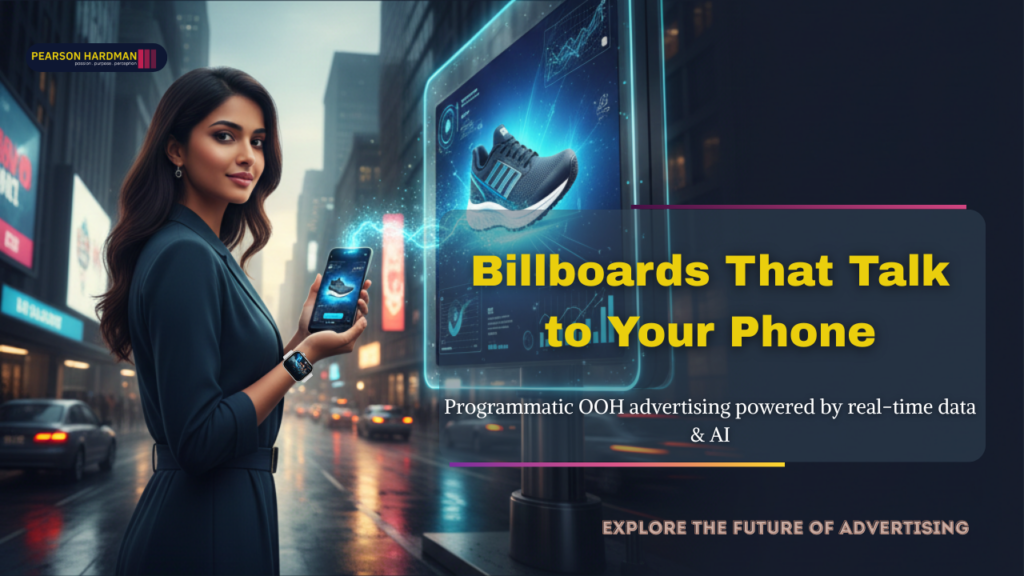
Imagine you are walking down a bustling city street on a crisp Tuesday afternoon in early 2026. As you wait for the crosswalk signal, your eyes drift toward a massive, vibrant digital screen displaying a stunning visual for a high-performance running shoe. You do not think much of it until five minutes later, while sitting in a local cafe, you open your favorite news app and see a tailored offer for that exact same pair of shoes. This is not a coincidence, and it certainly is not magic. It is the sophisticated reality of Programmatic OOH, a technology that has completely redefined how brands communicate with consumers in the physical world. In this new era of advertising, the traditional “set it and forget it” billboard is a relic of the past, replaced by an intelligent, interconnected ecosystem where digital displays effectively hold a conversation with the devices in our pockets.
For years, out of home advertising was considered the final frontier of unmeasurable marketing spend. You would pay a flat fee, put up a static vinyl sign, and hope that enough people drove past it to justify the cost. However, Programmatic OOH has shattered that old model by bringing the precision of digital data into the physical environment. Today, we are looking at a landscape where billboards are no longer just passive background noise but are active participants in an omnichannel marketing strategy. By the end of this article, you will understand exactly how Programmatic OOH works, why it has become the most powerful tool for localized targeting, and how it manages to sync up with your mobile phone to create a seamless journey from the sidewalk to the digital shopping cart.
The Evolution from Static Signage to Programmatic OOH
The transition from traditional billboards to Programmatic OOH represents one of the most significant shifts in the history of the advertising industry. In the early days, if a brand wanted to change an ad, they had to send a physical crew to climb a ladder and glue down new sheets of paper, a process that was both slow and expensive. When digital screens first arrived, they solved the manual labor problem, yet they were still governed by rigid loops that played the same ads regardless of who was watching. The introduction of Programmatic OOH changed everything by applying the principles of real-time bidding and data-driven decision making to these screens. This means that advertisers can now buy specific impressions based on live data, such as traffic patterns, weather conditions, or even the general demographics of the crowd nearby at any given moment.
Consequently, the efficiency of Programmatic OOH has made it a favorite for brands that previously avoided traditional outdoor media. Because you can now buy ads in small increments or only during specific times of day, the barrier to entry has dropped while the potential for a high return on investment has soared. For example, a breakfast brand can choose to only display their ads on transit screens between the hours of seven and nine in the morning when the commuter crowd is most active. This level of granularity is what defines Programmatic OOH in 2026, as it allows for a level of budget optimization that was previously only possible on social media or search engines. By treating the physical world like a digital inventory, advertisers are finally able to eliminate waste and focus their spend where it truly matters.
The Invisible Handshake: How Billboards and Phones Connect
Many people wonder how a billboard can possibly know that they are standing right in front of it, and the answer lies in the “invisible handshake” between mobile devices and digital out of home networks. While Programmatic OOH screens do not literally scan your face, they do interact with the anonymized location data transmitted by the thousands of mobile devices passing by. Through the use of geofencing and mobile advertising IDs, the digital out of home platform can identify the presence of a specific audience segment. Once a device enters a pre-defined geofence around a billboard, the system logs that exposure. This data is then used to trigger retargeting campaigns on that same user’s phone, which is the core reason why Programmatic OOH is so effective at bridging the gap between physical awareness and digital action.
This connection is highly regulated and focuses on privacy, yet it remains incredibly powerful for creating a cohesive brand experience. When a consumer sees a high-impact ad via Programmatic OOH on their way to work and then receives a related mobile notification during their lunch break, the brand recall increases exponentially. The billboard provides the initial visual “wow” factor, while the mobile device provides the “click-to-action” capability. This synergy is why Programmatic OOH has become the backbone of modern localized marketing, as it allows brands to surround their target audience in the real world while giving them an easy path to purchase on the devices they use most. It is a dual-layered approach that ensures the message is not just seen but is acted upon in a measurable way.
Dynamic Creative Optimization in Programmatic OOH
One of the most exciting aspects of Programmatic OOH is the ability to use Dynamic Creative Optimization, or DCO, to change the visual content of an ad in real time based on external triggers. In the past, an ad was a static image that had to appeal to everyone at all times, but Programmatic OOH allows for a much more personalized approach. Imagine a beverage company running a campaign where the billboard displays an iced tea when the temperature rises above eighty degrees, but automatically switches to a steaming hot coffee when a sudden rainstorm begins. This is not just a gimmick; it is a highly effective way to ensure that the ad remains relevant to the immediate environment and the mindset of the consumer.
Furthermore, Programmatic OOH can integrate live data feeds to show real-time scores for sports games, countdowns to product launches, or even current inventory levels at a nearby store. This level of contextual relevance is what makes Programmatic OOH feel more like a service and less like an interruption. When an ad provides the current wait time for a local movie theater or a live update on flight departures at a transit station, it captures attention in a way that a static sign never could. By leveraging these dynamic triggers, advertisers can ensure that their Programmatic OOH campaigns are always hitting the right note at the right time, leading to much higher engagement rates and a more positive perception of the brand in the eyes of the public.
Why Brands are Flocking to Programmatic OOH in 2026
As we move through 2026, the demand for Programmatic OOH has reached an all-time high because it offers a unique combination of high-impact visibility and digital precision. While the digital advertising space has become increasingly cluttered and plagued by ad-blockers, the physical world remains a place where ads cannot be skipped or scrolled past. Programmatic OOH takes advantage of this “unskippable” nature of the physical environment while providing the same measurement and targeting tools that digital marketers have come to rely on. Brands are realizing that they can achieve a higher CPM value by investing in premium digital screens in high-traffic areas, knowing that they are reaching real people in a fraud-free environment.
Moreover, the attribution capabilities of Programmatic OOH have finally solved the mystery of how outdoor ads drive foot traffic. By tracking the mobile devices that were exposed to a specific screen and then seeing if those same devices later entered a brick-and-mortar store, advertisers can clearly see the direct impact of their Programmatic OOH spend. This data-driven proof of performance has shifted Programmatic OOH from a “nice-to-have” awareness tool to a “must-have” performance driver. As more inventory becomes available through global supply-side platforms, the ability to launch massive, multi-city Programmatic OOH campaigns with the click of a button has made it easier than ever for brands of all sizes to dominate the physical landscape.
Privacy and Ethics in the Age of Programmatic OOH
With the increased tracking capabilities of Programmatic OOH, it is natural for concerns about privacy to arise among consumers and regulators alike. However, it is important to clarify that Programmatic OOH operates on a foundation of aggregated and anonymized data rather than individual surveillance. The industry has worked hard to establish strict protocols that ensure no personal identifiable information is ever shared or stored by the billboard owners or the programmatic platforms. Instead, Programmatic OOH relies on “audience clusters,” which categorize groups of people based on their general behaviors and interests without ever needing to know exactly who they are. This balance allows for high-precision targeting while respecting the boundaries of personal privacy.
In 2026, transparency has become a major selling point for Programmatic OOH networks. Leading providers are now open about how they collect location data and give consumers easy ways to opt-out of mobile tracking through their device settings. This ethical approach to Programmatic OOH is crucial for maintaining public trust, especially as the technology becomes more integrated into our daily lives. By prioritizing consumer privacy, the Programmatic OOH industry is ensuring that it can continue to innovate and grow without facing the same backlash that has troubled other sectors of the digital advertising world. When handled correctly, this technology serves as a bridge that benefits both the brand and the consumer, providing relevant information in a way that is respectful and secure.
The Role of AI in Scaling Programmatic OOH Campaigns
Artificial intelligence has played a pivotal role in the explosion of Programmatic OOH by automating the complex decision-making processes required to buy and place ads across thousands of screens. In the early days of programmatic, marketers still had to manually set many of the parameters for their campaigns, but today’s AI-driven platforms can optimize Programmatic OOH spend in real time with minimal human intervention. These systems can analyze vast amounts of historical data to predict exactly when and where an ad will have the highest impact, adjusting bids on the fly to ensure the best possible price. This level of automation is what allows Programmatic OOH to function at scale, making it possible for a single campaign to span across different countries and time zones effortlessly.
Additionally, AI is being used to enhance the creative side of Programmatic OOH by analyzing which visual elements are most effective at capturing attention in different environments. By studying the dwell time and gaze patterns of crowds, AI can suggest changes to color schemes, font sizes, or imagery to maximize the visibility of a Programmatic OOH ad. This means that the creative content is constantly evolving to be more effective, ensuring that the advertiser’s message never becomes stale. As AI continues to mature, we can expect Programmatic OOH to become even more intuitive, with screens that can anticipate the needs of a crowd before they even realize it themselves. It is a powerful fusion of technology and creativity that is setting a new standard for the entire marketing industry.
Overcoming the Challenges of Programmatic OOH Integration
Despite the many advantages, the integration of Programmatic OOH into a standard marketing mix is not without its challenges. One of the primary hurdles is the fragmentation of inventory, as different digital screens are owned by various media companies with different technical standards. However, the rise of unified demand-side platforms has significantly mitigated this issue, allowing marketers to access a wide range of Programmatic OOH inventory through a single interface. This standardization is essential for the continued growth of the medium, as it allows for the kind of “one-stop-shopping” experience that advertisers have come to expect from digital platforms.
Another challenge involves the creative requirements of Programmatic OOH, which differ greatly from mobile or desktop ads. A billboard must be legible from a distance and capture attention in just a few seconds, which requires a specific set of design skills. Marketers must learn how to adapt their digital assets for the large-format, high-contrast environment of Programmatic OOH to ensure their message is not lost in the noise of the city. Education and training are key here, as more creative agencies begin to specialize in the unique demands of programmatic outdoor media. By addressing these technical and creative barriers, the industry is clearing the way for Programmatic OOH to become a truly universal advertising medium that can be used by any brand, anywhere in the world.
The Future: Augmented Reality and Programmatic OOH
Looking further into the future, the intersection of Programmatic OOH and augmented reality promises to create even more immersive brand experiences. We are already seeing the first stages of this in 2026, where consumers can point their phones at a digital billboard and see 3D content layered over the physical world. This combination of Programmatic OOH and AR turns a simple ad into an interactive playground, allowing users to play games, virtually try on products, or explore a brand’s story in a way that was never before possible. The billboard acts as the trigger, while the phone provides the interface for a deep, personalized engagement.
This evolution will further solidify Programmatic OOH as the anchor for experiential marketing campaigns. Instead of just seeing an ad for a new movie, you might see a dragon fly off the billboard and circle around your phone screen, leading you to a nearby theater to buy tickets. This level of immersion is the ultimate goal of Programmatic OOH, as it erases the line between the physical and the digital entirely. As AR glasses become more common toward the end of the decade, the potential for Programmatic OOH to become a permanent, interactive layer of our urban environment is incredibly high. The journey is just beginning, and the brands that embrace these technologies now will be the ones leading the way in the years to come.
Conclusion: Embracing the New Era of Advertising
The world of Programmatic OOH is no longer a futuristic concept but a thriving, essential part of the modern marketing landscape in 2026. We have moved beyond the age of silent, static signs and entered a period where the physical environment is just as intelligent and responsive as the digital one. By understanding the mechanics of Programmatic OOH, brands can create powerful, localized campaigns that resonate with consumers on both a visual and a personal level. The ability to make billboards “talk” to phones has fundamentally changed the consumer journey, making it more fluid, relevant, and measurable than ever before.
As you look to the future of your own marketing strategy, consider how Programmatic OOH can bridge the gap between your digital presence and the physical world. The brands that will succeed in the coming years are those that recognize the power of this interconnected ecosystem and use it to build deeper, more meaningful relationships with their audience. Whether you are a global enterprise or a local startup, the opportunities provided by Programmatic OOH are too significant to ignore. It is time to step out of the digital bubble and embrace the limitless potential of the high-tech, high-impact world of programmatic out of home advertising.