The luxury fashion world is currently witnessing a paradigm shift that has completely redefined the meaning of exclusivity and prestige as we navigate through the opening months of 2026. For decades, high-end brands relied on an aura of mystery and the unspoken promise of quality to justify their premium price points, but that era of “blind faith” has effectively come to an end. Today, the most sophisticated consumers are no longer satisfied with just a logo or a heritage narrative because they demand to see the biological and ethical receipt of every garment they purchase. This evolution has given rise to a new industry standard that we call Sustainable Glamour: Traceability as a Marketing Hook. It is a movement where radical transparency is not just a compliance requirement but the ultimate status symbol for a generation that views ethics as the new luxury. The problem many legacy brands face is that their supply chains are still too opaque, leaving them vulnerable to a growing trust gap that only full disclosure can bridge.
In this comprehensive exploration of Sustainable Glamour: Traceability as a Marketing Hook, we will examine how the integration of forensic science and digital technology is transforming the relationship between designer and wearer. We will look at how high-net-worth individuals, particularly the influential Gen Z cohort who are now entering their prime spending years, are prioritizing “provenance” over “perception.” You will learn how brands are using everything from blockchain ledgers to isotope testing to verify that their “organic” cotton or “cruelty-free” silk is exactly what it claims to be. At Pearson Hardman, we have seen that the brands leading the market in 2026 are those that have turned their supply chain into their primary marketing narrative. By the end of this article, you will understand the strategic roadmap for implementing Sustainable Glamour: Traceability as a Marketing Hook and how it can solidify your brand’s authority in an increasingly conscious global marketplace.
The Psychological Shift: Why 2026 Consumers Demand Provenance
The primary driver behind the success of Sustainable Glamour: Traceability as a Marketing Hook is a fundamental change in the consumer psyche regarding value and identity. In 2026, luxury is no longer defined solely by the rarity of the material or the difficulty of the craftsmanship but by the “purity” of the journey from source to shelf. The modern conscious consumer feels a sense of stewardship over their wardrobe and views every purchase as a vote for the kind of world they want to inhabit. Consequently, a brand that cannot explain exactly where its leather was tanned or who dyed its yarns is seen as a brand with something to hide. This demand for provenance is a direct response to years of “greenwashing” that left buyers skeptical of vague sustainability claims. Now, Sustainable Glamour: Traceability as a Marketing Hook serves as the verifiable proof that restores that broken bond of trust.
This shift is particularly evident in the rise of “Value-Led Consumption” among the oldest Gen Z professionals, who are now nearly thirty years old and making significant household decisions. They are looking for “Affordable Aspiration” that aligns with their personal morals, and they use fashion as a tool for self-expression that goes beyond aesthetics. When a brand utilizes Sustainable Glamour: Traceability as a Marketing Hook, it provides these consumers with the intellectual and emotional satisfaction of knowing their glamour doesn’t come at a hidden human or environmental cost. It turns the garment into a conversation piece where the “story” is just as beautiful as the silhouette. In the 2026 market, a traceable supply chain is the most powerful “feature” a product can have, often outweighing traditional factors like brand name or seasonal trendiness.
Technology Behind the Veil: Blockchain and Forensic Tracers
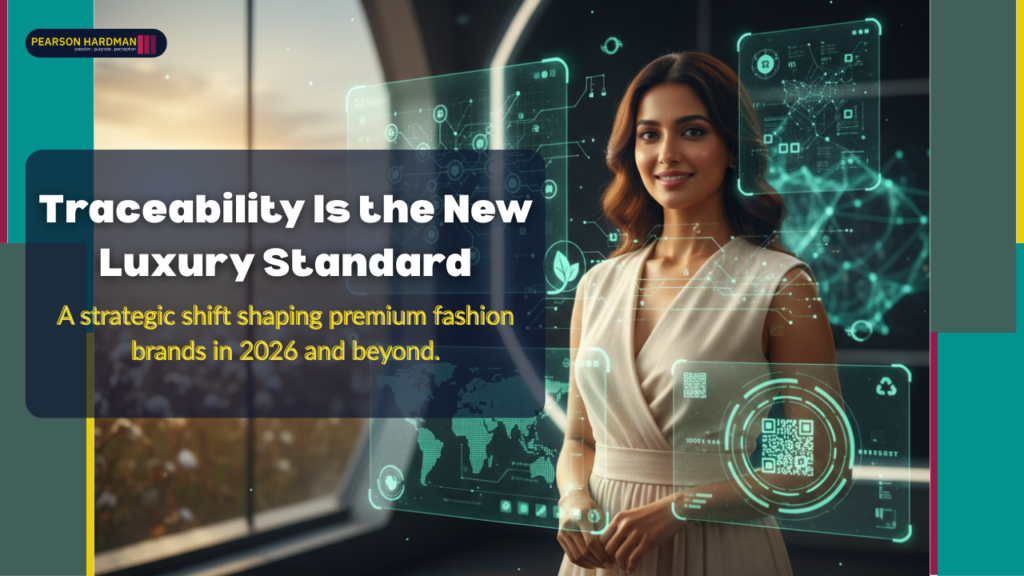
The realization of Sustainable Glamour: Traceability as a Marketing Hook is made possible by a sophisticated suite of technologies that have moved from experimental pilots to industry-standard tools. Blockchain technology is at the heart of this revolution, providing a tamper-proof digital ledger that records every transaction and transformation a product undergoes. When we talk about Sustainable Glamour: Traceability as a Marketing Hook, we are talking about a system where a simple QR code on a care label can reveal a chronological map of a garment’s life. This digital “handshake” between suppliers ensures that data cannot be forged or manipulated, creating a level of accountability that was previously impossible. It allows brands to prove their ethical luxury fashion credentials with cold, hard data that is accessible to the consumer in real-time.
Beyond the digital realm, forensic tracers are now being used to provide physical validation of material claims within the framework of Sustainable Glamour: Traceability as a Marketing Hook. Isotope testing and DNA “fingerprinting” allow brands to analyze the unique micro-particle composition of natural fibers like wool and cotton to verify their exact geographic origin. For example, a brand can now prove that its Egyptian cotton actually came from the specific region in Egypt it claims, rather than a lower-quality substitute. Additive tracers, such as invisible fluorescent inks or microscopic “dust” applied at the fiber level, enable end-to-end tracking through the spinning, weaving, and dyeing processes. These innovations are the backbone of Sustainable Glamour: Traceability as a Marketing Hook, ensuring that the “glamour” is backed by forensic truth and protecting the brand from the reputational risks of unintended supply chain violations.
Beyond Greenwashing: The Legislative Push for Digital Product Passports
One of the most significant changes we are seeing in 2026 is the transition of transparency from a voluntary “nice-to-have” to a mandatory legal requirement. The implementation of Digital Product Passports (DPP) in the European Union and parts of North America has fundamentally altered the landscape of Sustainable Glamour: Traceability as a Marketing Hook. These passports are digital records that store comprehensive information about a product’s materials, environmental impact, and circularity potential. Brands are now required by law to disclose the carbon footprint of their items and provide instructions for repair or recycling. This legislation has effectively killed the era of vague marketing slogans, forcing companies to adopt Sustainable Glamour: Traceability as a Marketing Hook as a core part of their operational DNA if they wish to maintain market access.
For the savvy marketer, these legislative mandates are not a burden but a massive opportunity to lean into Sustainable Glamour: Traceability as a Marketing Hook. Instead of doing the bare minimum for compliance, leading brands are using the Digital Product Passport as a platform for immersive storytelling. They are turning a regulatory requirement into a premium customer experience, using augmented reality to allow users to “walk through” the organic silk farms or meet the artisans via their smartphones. By being a first-mover in Sustainable Glamour: Traceability as a Marketing Hook, a brand signals that it is ahead of the curve and fully confident in its practices. It transforms the “glamour” of the product into an interactive educational journey, reinforcing the brand’s position as a leader in conscious consumerism 2026.
Sourcing Secrets: From Lab-Grown Silk to Regenerative Cotton
The materials used in 2026 are just as innovative as the technology used to track them, and they form the physical substance of Sustainable Glamour: Traceability as a Marketing Hook. We have moved beyond basic recycling and into the era of “Regenerative” and “Lab-Grown” luxury. Lab-grown silk and mycelium-based “leathers” have become commercially viable and highly sought after by the conscious traveler 2026 and the fashion-forward elite. These materials offer a consistent quality and a significantly lower environmental impact than their traditional counterparts. When combined with Sustainable Glamour: Traceability as a Marketing Hook, these materials become the ultimate expression of modern elegance because their entire “clean” history is verifiable and transparent to the end user.
Furthermore, the revival of ancient, regenerative farming techniques for materials like cotton and linen is providing a rich narrative for Sustainable Glamour: Traceability as a Marketing Hook. Brands are partnering directly with Tier-1 suppliers who practice soil-sequestering agriculture, ensuring that their fashion choices actually help to heal the planet. This level of “Micro-Sourcing” allows a brand to bypass the complexity of global commodity markets and build deep, traceable relationships with specific communities. By highlighting these specific partnerships through Sustainable Glamour: Traceability as a Marketing Hook, brands create a sense of “Local Globalism” that resonates deeply with consumers who are tired of mass-produced, anonymous goods. It turns every garment into a limited-edition piece of history that the wearer can be proud to own and explain.
Marketing the Journey: How to Tell a Traceable Brand Story
The key to successfully implementing Sustainable Glamour: Traceability as a Marketing Hook lies in the art of storytelling. Data alone is not enough to capture the imagination of a luxury consumer; the information must be presented with the same aesthetic care as the product itself. Brands must move away from clinical reports and toward “Narrative Transparency.” This means using high-quality cinematography to document the harvesting of raw materials or creating “Artisan Spotlights” that introduce the people behind the seams. When a brand masters Sustainable Glamour: Traceability as a Marketing Hook, the supply chain becomes the “Main Character” of the marketing campaign, providing the emotional resonance that builds long-term loyalty and justifies the premium investment.
Another powerful strategy for Sustainable Glamour: Traceability as a Marketing Hook is the use of “Real-Time Impact Tracking.” Imagine a customer being able to see exactly how much water was saved or how many kilograms of CO2 were avoided by choosing a specific traceable item over a conventional one. This immediate feedback loop provides a “dopamine hit” of ethical satisfaction that reinforces the purchase decision. It makes the consumer feel like an active participant in the brand’s mission rather than just a passive buyer. By integrating these metrics into the digital shopping experience, Sustainable Glamour: Traceability as a Marketing Hook creates a frictionless path to conversion for the conscious consumer 2026. It turns the “glamour” into a measurable force for good, which is the most compelling marketing hook in the current climate.
The Future of Circularity: Resale Value and Lifetime Accountability
In 2026, the life of a luxury product no longer ends at the initial sale, and this “Extended Responsibility” is a cornerstone of Sustainable Glamour: Traceability as a Marketing Hook. The rise of the luxury resale market has made “Resale Value” a primary consideration for new purchases. A garment that is fully traceable is far more valuable on the secondary market because its authenticity and condition are documented in its Digital Product Passport. This means that Sustainable Glamour: Traceability as a Marketing Hook actually serves as a financial protection for the consumer, guaranteeing that their investment will hold its worth over time. Brands that facilitate this through their own resale platforms are seeing massive gains in customer lifetime value and brand prestige.
Moreover, Sustainable Glamour: Traceability as a Marketing Hook enables a brand to offer “Lifetime Accountability” for its products. This includes offering repair services, “Take-Back” schemes, and upcycling programs that are all tracked through the original digital identity of the item. When a brand knows exactly what materials were used and how they were assembled, they can provide a much higher level of service throughout the product’s entire lifecycle. This “Closed-Loop” approach is the ultimate goal of Sustainable Glamour: Traceability as a Marketing Hook, ensuring that nothing ever ends up in a landfill. It transforms the brand from a seller of goods into a lifelong partner in the consumer’s lifestyle, creating an unbreakable bond based on mutual values and shared responsibility for the planet.
Case Studies: Brands Winning with Radical Transparency
Several pioneers in the industry have already demonstrated the immense power of Sustainable Glamour: Traceability as a Marketing Hook. For instance, the high-end jewelry sector has been transformed by brands that track every diamond and gemstone from the specific mine to the final setting. By using Sustainable Glamour: Traceability as a Marketing Hook, these brands have managed to charge a “Trust Premium” that far exceeds the market price of untraced stones. They aren’t just selling jewelry; they are selling peace of mind and ethical certainty. Similarly, in the world of high-performance outdoor gear, we see brands using Sustainable Glamour: Traceability as a Marketing Hook to prove the durability and environmental safety of their technical fabrics, which has become a non-negotiable requirement for the modern adventurer.
In the luxury apparel space, a prominent Italian house recently launched a collection where every single piece was accompanied by a “Traceability Map” that included interviews with every supplier involved. This campaign used Sustainable Glamour: Traceability as a Marketing Hook to celebrate the “Human Element” of fashion, resulting in one of the most successful launches in the brand’s history. It proved that consumers are hungry for connection and truth in an age of digital noise. These case studies highlight that Sustainable Glamour: Traceability as a Marketing Hook is not a niche trend for “eco-brands” but a powerful strategic tool for any brand that wants to lead the luxury market in 2026. It is about taking the “glamour” of the past and infusing it with the “integrity” of the future.
Conclusion: Leading the Ethical Revolution in Style
The emergence of Sustainable Glamour: Traceability as a Marketing Hook represents the most significant evolution in the luxury industry since the rise of global branding. We are moving toward a future where “Glitter” is only respected if the “Gold” is clean. As we move further into 2026, the brands that will define the cultural zeitgeist are those that treat transparency not as a challenge to be managed, but as a masterpiece to be showcased. By adopting the principles of Sustainable Glamour: Traceability as a Marketing Hook, you are doing more than just selling a product; you are leading a revolution in how we value the items we wear and the people who make them.
At Pearson Hardman, we believe that the ultimate luxury is truth. The tools of the circular economy, forensic science, and digital storytelling are now in your hands. The question is no longer whether you can afford to be traceable, but whether you can afford to remain opaque in a world that is finally opening its eyes. Embrace Sustainable Glamour: Traceability as a Marketing Hook and turn your supply chain into your greatest competitive advantage. The journey from source to shelf is the new runway—make sure your brand’s walk is flawless.