Introduction
Newspaper advertising has always been associated with credibility, reach, and trust. For decades, brands have relied on print media to build awareness and communicate their message to a wide audience. However, in today’s fast-moving digital ecosystem, attention alone is no longer enough. The real challenge is converting that attention into measurable action. This is where interactive print using AR in newspaper ads is transforming the way brands approach traditional advertising.
Consumers today are no longer passive readers. They expect interaction, personalization, and instant results. A static newspaper ad, no matter how visually appealing, often fails to deliver that level of engagement. This gap between visibility and action has pushed marketers to innovate. By integrating augmented reality into print, brands are now turning ordinary newspaper ads into immersive digital experiences that drive real-time engagement and conversions.
In this article, you will understand how AR in newspaper ads works, why interactive print advertising is becoming a high-performing marketing strategy in 2026, and how businesses can leverage this approach to create meaningful customer journeys that lead to instant conversions. The insights shared here are practical, research-backed, and aligned with modern SEO and content standards, making this guide valuable for marketers, business owners, and digital strategists.
The Evolution of Print Media in the Digital Age
Print media has never truly lost its relevance. While digital platforms have expanded rapidly, newspapers continue to hold a unique position in the marketing ecosystem due to their credibility and audience trust. However, the role of print has evolved significantly. It is no longer just about delivering information. It is about creating experiences that connect offline audiences with online ecosystems.
The emergence of interactive print using AR in newspaper ads represents a natural progression in this evolution. Instead of competing with digital channels, print is now integrating with them. This integration allows brands to leverage the strengths of both mediums. Print offers trust and reach, while digital provides interactivity and measurability.
This shift is particularly important in an era where customer journeys are no longer linear. A user might discover a brand offline, research it online, and make a purchase through a mobile device. Interactive print advertising acts as a bridge in this journey, enabling seamless transitions between physical and digital touchpoints. This not only enhances user experience but also increases the likelihood of conversion.
Also Read: The Trust Economy: Positioning Your Brand as Human-Verified in an AI World
What is Interactive Print Using AR in Newspaper Ads
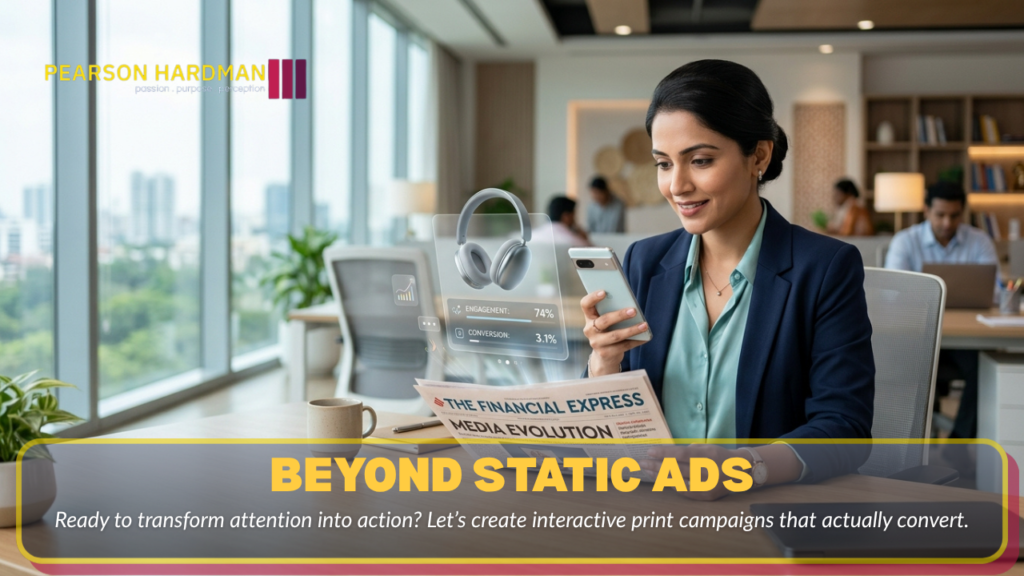
Interactive print using AR in newspaper ads refers to the integration of augmented reality technology into traditional print advertisements. It allows users to scan a printed ad using their smartphone and instantly unlock digital content layered over the physical page.
This digital layer can include videos, 3D product visualizations, clickable links, lead forms, or even direct purchase options. The key advantage here is immediacy. Users do not need to search for a website or remember a brand name. The entire experience is accessible within seconds through a simple scan.
From a marketing perspective, AR in newspaper ads transforms print from a one-way communication channel into a two-way interactive platform. It allows brands to engage users in real time, collect data, and guide them toward a specific action. This level of engagement was previously impossible with traditional print advertising.
Why AR in Newspaper Ads is Driving Instant Conversions
One of the biggest reasons why interactive print advertising is gaining traction is its ability to drive instant conversions. Unlike traditional ads that rely on delayed action, AR-enabled ads create immediate opportunities for engagement and decision-making.
When a user scans an AR-enabled newspaper ad, they are already demonstrating intent. This intent can be leveraged instantly by providing relevant and compelling digital experiences. For example, a real estate ad can offer a virtual property tour, while a retail ad can provide a limited-time discount with a direct purchase option.
This immediacy reduces friction in the customer journey. Users do not have to switch platforms, search for information, or go through multiple steps. Everything they need is available within the AR experience. This seamless interaction significantly increases conversion rates.
Additionally, AR in newspaper ads creates a sense of novelty and excitement. Users are more likely to engage with something that feels innovative and different. This emotional engagement plays a crucial role in influencing purchasing decisions and building brand recall.
How Interactive Print Advertising Enhances User Engagement
Engagement is the foundation of any successful marketing campaign. Without engagement, even the most creative ads fail to deliver results. Interactive print using AR in newspaper ads addresses this challenge by transforming passive consumption into active participation.
When users interact with an AR-enabled ad, they are not just viewing content. They are experiencing it. This experience can involve exploring a product in 3D, watching a story unfold, or interacting with a brand in a meaningful way. Such experiences create deeper connections and leave a lasting impression.
Moreover, interactive print advertising caters to the preferences of modern consumers who are accustomed to digital interactivity. It aligns with their expectations and provides a familiar yet innovative way to engage with brands. This alignment enhances user satisfaction and increases the likelihood of repeat interactions.
Another important aspect is personalization. AR experiences can be tailored based on user behavior and preferences, making the interaction more relevant and impactful. This level of personalization further strengthens engagement and drives better results.
Real-World Applications of AR in Newspaper Ads
The practical applications of interactive print using AR in newspaper ads are vast and continue to expand across industries. In the real estate sector, developers are using AR to provide virtual walkthroughs of properties directly from newspaper ads. This not only saves time but also attracts high-intent buyers.
In the retail industry, brands are leveraging AR in newspaper ads to create virtual try-on experiences. Customers can see how a product looks on them without visiting a physical store. This convenience enhances the shopping experience and increases conversion rates.
Automotive companies are using interactive print ads to showcase vehicle features through immersive 3D models. Users can explore the car, understand its specifications, and even book a test drive instantly. This level of interaction significantly improves customer engagement and decision-making.
Educational institutions are also adopting interactive print advertising to provide detailed information about courses, campus facilities, and admission processes. By simplifying the information flow, they are able to attract and convert prospective students more effectively.
Strategic Benefits of Interactive Print Advertising
The adoption of interactive print using AR in newspaper ads offers several strategic advantages for businesses. One of the most significant benefits is the ability to measure performance. Unlike traditional print ads, AR-enabled ads provide data on user interactions, engagement time, and conversion rates.
This data-driven approach allows marketers to optimize their campaigns and make informed decisions. It also helps in understanding customer behavior and preferences, which can be used to improve future marketing strategies.
Another key benefit is brand differentiation. In a crowded market, standing out is essential. AR in newspaper ads provides a unique way to capture attention and create memorable experiences. This not only enhances brand perception but also builds a competitive advantage.
Cost efficiency is another important factor. While the initial investment in AR technology may seem high, the long-term benefits in terms of engagement, data collection, and conversions make it a highly cost-effective solution. It also complements digital marketing efforts, creating a cohesive and integrated strategy.
Challenges in Implementing AR in Newspaper Ads
Despite its advantages, implementing interactive print advertising comes with certain challenges. One of the primary challenges is user awareness. Not all readers are familiar with AR technology, and some may hesitate to engage with it. Brands need to educate their audience and provide clear instructions to ensure adoption.
Another challenge is the quality of execution. A poorly designed AR experience can lead to frustration and negatively impact brand perception. It is essential to focus on user experience and ensure that the interaction is smooth, intuitive, and valuable.
Technical limitations can also pose challenges, especially in regions with limited internet connectivity or older devices. However, as technology continues to advance, these limitations are gradually being addressed.
The Future of Interactive Print Using AR in Newspaper Ads
The future of AR in newspaper ads is incredibly promising. As technology evolves, we can expect more sophisticated and immersive experiences that further enhance user engagement. Integration with artificial intelligence will enable personalized content, while advancements in mobile technology will make AR experiences more accessible.
E-commerce integration is another area of growth. Users will be able to complete transactions directly within the AR experience, making the process faster and more convenient. This will further strengthen the role of interactive print advertising in driving instant conversions.
As consumer expectations continue to evolve, brands that adopt innovative approaches like interactive print using AR in newspaper ads will be better positioned to succeed. This strategy not only enhances engagement but also aligns with the future of marketing, where seamless and immersive experiences are key.
Also Read: Why Brand Identity Is Critical Before Running Any Campaign
Conclusion
The integration of augmented reality into print media is redefining the way brands communicate with their audience. Interactive print using AR in newspaper ads is not just an innovation, it is a strategic shift toward more engaging and conversion-driven marketing.
By combining the trust of print with the power of digital interactivity, brands can create experiences that capture attention, build relationships, and drive immediate action. In a competitive market, this ability to connect and convert instantly is a significant advantage.
As we move further into 2026, the question is no longer whether businesses should adopt this approach, but how quickly they can implement it effectively. The brands that embrace interactive print advertising today will lead the marketing landscape of tomorrow.