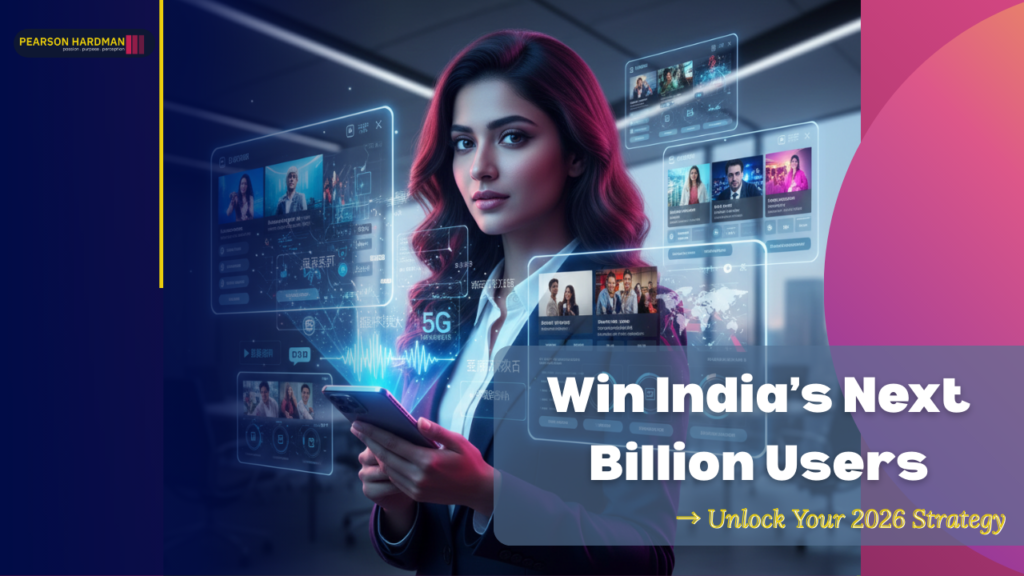
The Indian digital landscape is undergoing a tectonic shift that most traditional marketing playbooks aren’t prepared for. As we move closer to 2026, the era of “type and search” is being rapidly eclipsed by a more intuitive, human-centric way of interacting with technology. For a brand in India, the challenge is no longer just appearing on the first page of Google; it is appearing in the ears and on the screens of a billion people who increasingly prefer to speak their queries and watch their answers. With the explosion of affordable 5G data and the massive influx of first-time internet users from Tier-2 and Tier-3 cities, the traditional text-heavy internet is becoming a secondary experience. If your brand is still obsessing over 2020-style SEO without integrating a robust voice and video strategy, you are essentially whispering in a room where everyone else is using a megaphone. At Pearson Hardman, we believe that the future of brand authority in India lies at the intersection of vernacular voice search and short-form immersive video.
This transformation is driven by a fundamental change in user behavior. The modern Indian consumer is mobile-first, multilingual, and extremely time-poor. They don’t want to navigate complex menus or read long paragraphs to find a product; they want to ask “Best SUV konsi hai?” or see a 30-second reel of a kitchen gadget in action. This shift toward conversational and visual discovery is what we call the “Humanization of Search.” For Indian brands, this is the ultimate opportunity to build deep, emotional trust at scale. In this comprehensive guide, we will explore why voice search and video are the twin engines of growth for 2026 and how you can architect a strategy that doesn’t just capture traffic, but dominates the market narrative.
The Voice Revolution: Speaking the Language of a Billion
The rise of voice search in India is not just a technological trend; it is a cultural movement. Unlike Western markets where voice search is often used for simple tasks like setting timers, the Indian user uses voice as their primary gateway to the internet. This is largely because the complexity of typing in regional scripts like Devanagari, Tamil, or Telugu is a significant friction point. For millions of new users, speaking is natural, while typing is a chore. By 2026, it is estimated that over 60% of all internet searches in India will be voice-initiated. This creates a massive demand for “Conversational SEO.” Brands that fail to optimize for natural language patterns will find themselves invisible to a audience that no longer “searches” for keywords but “asks” for solutions.
To win in this voice-first era, you must understand the nuance of “Hinglish” and regional dialects. A user in Delhi might ask, “Mere paas sabse sasta petrol pump kahan hai?” while a user in Chennai might ask for the same in Tamil. Your content strategy must move away from stiff, corporate language and toward the way people actually talk at the dinner table. This means your SEO strategy must prioritize long-tail, question-based keywords. Instead of targeting “Best Real Estate Pune,” you should be targeting “Pune mein 2BHK flat ka price kya hai?” or “Best residential areas near Hinjewadi IT park.” This level of specificity is what triggers voice assistants like Alexa, Google Assistant, and Siri to pick your brand as the definitive answer. At Pearson Hardman, we help our clients build an “Answer Engine” strategy that positions them as the trusted voice in their niche.
The technical side of voice search is equally critical. Since voice assistants typically only provide one “top” answer, being in the “Position Zero” or the Featured Snippet is the only way to win. This requires a heavy focus on structured data and schema markup. By giving search engines a clear, structured roadmap of your content, you make it easier for AI to extract the exact answer a user is looking for. Furthermore, website speed is a non-negotiable factor. Voice searchers are usually on the go and expect instant results. If your site takes five seconds to load, the voice assistant will move on to a faster competitor. In 2026, speed is not just a ranking factor; it is a trust factor. A slow site is a silent site, and in the voice revolution, silence is the fastest way to lose market share.
Video Dominance: Moving Beyond Static Content
If voice search is the brain of the new Indian internet, video marketing is its heart. We have officially moved past the era where video was an “optional” part of the marketing mix. In 2026, video is the primary way Indian consumers discover, evaluate, and buy products. The success of platforms like YouTube Shorts and Instagram Reels has proven that attention is the most valuable commodity, and nothing captures it faster than a 15-second immersive clip. For Indian brands, video is the ultimate tool for “Visual Social Proof.” A high-quality product video in a regional language does more for trust than a thousand words of translated copy ever could. It bridges the gap between the digital screen and the physical product, giving the consumer the confidence to hit the “Buy” button.
The trend of “Shoppable Video” is set to explode in 2026. Imagine a consumer watching a reel of a new fashion launch or a home decor tip and being able to purchase the items directly through the video interface. This removes the friction of the traditional sales funnel, turning “discovery” into “transaction” in a single click. For brands, this means your video strategy must be high-intent. Every piece of content should not just entertain but also educate and guide the user toward a clear call to action. Whether it’s a “30-second hack” or a “behind-the-scenes” look at your manufacturing process, your videos need to be architected for conversion. At Pearson Hardman, we advocate for a “Multilingual Video First” approach, ensuring that your brand story is told in the languages your customers actually speak and think in.
Technical Video SEO is the secret sauce that separates viral hits from strategic assets. In 2026, Google’s AI can “read” video content more accurately than ever before. This means your video titles, descriptions, and even the spoken words in your script are crawlable data points. Optimizing your video metadata with conversational keywords is essential for appearing in both traditional search and video-specific carousels. Moreover, the use of chapters and timestamps allows search engines to point users to the exact segment of your video that answers their question. This “Micro-Moment” optimization ensures that even a 10-minute deep-dive video can be broken down into bite-sized answers for voice search queries. By treating video as a structured data asset, you ensure it works for you 24/7 across every touchpoint of the customer journey.
The Intersection: Multimodal Discovery in 2026
The true power of 2026 marketing lies in the synergy between voice and video, a phenomenon known as “Multimodal Discovery.” A customer’s journey might start with a voice query on their smart speaker—”Show me the latest EV scooters in India”—and end with them watching a detailed YouTube comparison on their mobile phone. These touchpoints are no longer siloed; they are part of a continuous, fluid experience. Brands that can provide a seamless transition between these formats will be the ones that dominate. This requires an integrated content ecosystem where your voice-optimized FAQs lead naturally into your video explainers. You are not just providing information; you are providing an experience that meets the user exactly where they are, in whatever format they prefer at that moment.
Interactive video experiences are the next frontier. We are seeing a rise in videos where users can choose their own path—asking a voice command like “Show me the interior” or “Tell me about the mileage” during a car walkthrough video. This level of interactivity turns passive viewers into active participants. For Indian brands, this is a game-changer for high-ticket items like real estate, automotive, and luxury goods. It allows you to provide a personalized, high-touch experience without the need for a physical sales executive. By combining the natural feel of voice with the visual power of video, you create a “Digital Showroom” that is accessible to anyone, anywhere in India, at any time.
Strategic ROI: Why This Matters for Your Bottom Line
Investing in voice and video is not just about being “trendy”; it is about maximizing your ROI in an increasingly expensive ad market. As CPC (Cost Per Click) and CPM (Cost Per Mille) benchmarks continue to rise for traditional text-based ads, organic discovery through voice and video becomes a critical cost-saving measure. A well-optimized video can continue to drive traffic for years, providing a much higher long-term value than a one-time paid ad. Furthermore, voice search users tend to have higher intent. When someone asks, “Where is the nearest car dealership open now?”, they are likely ready to visit. Capturing these high-intent “Micro-Moments” through voice SEO significantly increases your conversion rates and lowers your overall customer acquisition cost.
Trust and authenticity are the biggest drivers of conversion in 2026. In an era of AI-generated noise, a human face on camera and a human voice in the ear are the ultimate differentiators. Consumers are moving away from polished, corporate commercials toward “Creator-Style” content that feels real and relatable. This is why we see micro-influencers and founder-led videos performing so well in the Indian market. By showing the people behind the brand and speaking the user’s language—literally and figuratively—you build a “Reputation Reservoir.” This trust becomes your safety net during market fluctuations and your fuel during periods of growth. At Pearson Hardman, we don’t just help you get clicks; we help you build a brand that people actually like and trust.
Conclusion: Future-Proofing Your Brand Narrative
The digital world of 2026 will not be won by the brands that have the most content, but by the ones that have the most accessible and authentic content. Voice search and video are the bridge between your brand and the next billion Indian users. They are the tools that allow you to transcend the limitations of text and build a brand that is heard, seen, and felt. By embracing these trends today, you are not just keeping up with the competition; you are setting the pace for the entire industry.
At Pearson Hardman, we don’t just observe the future; we architect it. We know that the transition to a voice-and-video-first world can be daunting, but it is also the most exciting opportunity for brand growth we have seen in decades. The microphone is live, and the camera is rolling. The only question is: Is your brand ready to speak up?
The future is loud, visual, and human. Let’s make sure your brand is the one leading the conversation. Contact us for a future-ready strategy audit today.