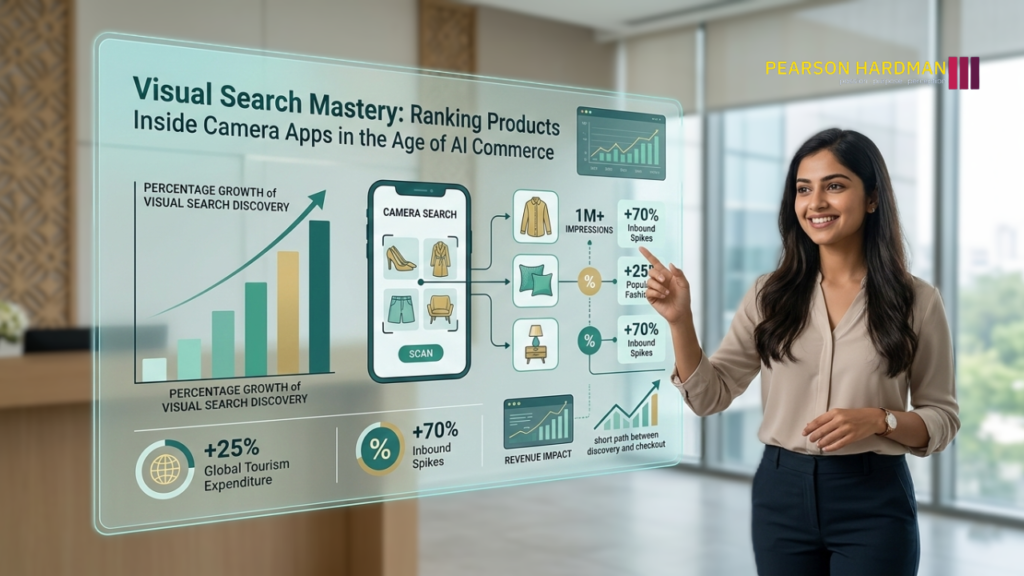
Introduction: The Camera Has Become the New Search Engine
A consumer stands inside a retail store in Mumbai. She notices a designer lamp but does not ask the salesperson. Instead, she opens her phone, scans the product using her camera, and within seconds she sees similar options, price comparisons, reviews, and online purchasing links. No typing. No browsing. No traditional search.
This moment captures one of the most significant shifts in digital commerce. Search is no longer text-driven. It is increasingly visual.
Visual search mastery is now a strategic imperative for brands that sell products online. Ranking products inside camera apps such as Google Lens, Pinterest Lens, and AI-integrated ecommerce scanners is becoming as critical as ranking on Google Search was a decade ago.
In 2026, the brands that understand visual search mastery will dominate product discovery. Those who ignore it will slowly lose visibility in the most frictionless buying channel ever created.
This article explores how visual search works, why ranking products inside camera apps matters strategically, and how businesses can build a future-ready visual commerce ecosystem.
The Structural Shift from Keyword Search to Visual Discovery
For over twenty years, digital marketing revolved around text queries. Search engine optimization meant targeting keywords, building backlinks, and structuring content around search intent. That model is not disappearing, but it is evolving.
Today, AI-powered visual recognition systems can interpret objects, patterns, textures, brand marks, and contextual elements inside images. When a user scans a product with their camera, the system does not read words. It reads pixels, geometry, color gradients, and shape signatures.
This fundamentally changes ranking logic.
Instead of asking, “How do I rank for this keyword?” brands must now ask, “How does my product look to an AI model?”
In markets like Pune, Bangalore, and Delhi, mobile-first consumers are already comfortable using camera-based search for fashion, home decor, electronics, and beauty products. Globally, large retail platforms are investing billions into AI image recognition to reduce search friction.
Visual search mastery therefore sits at the intersection of AI, ecommerce SEO, structured data, and brand presentation.
Also Read: Culinary Tourism: How Short-Form Video Sells Culture and Cuisine
How Visual Search Engines Rank Products
To rank products inside camera apps, we must understand how AI recognition platforms evaluate content.
Visual search engines rely on several layers of analysis:
First, computer vision models extract object features such as outline, dimensions, color distribution, and texture patterns. These features are converted into data points that are matched against indexed image databases.
Second, contextual signals are applied. These include surrounding text, structured data markup, product category alignment, and user behavior patterns.
Third, ranking algorithms prioritize results based on relevance, authority, engagement signals, and page performance.
This means visual search mastery is not only about uploading attractive images. It is about building a complete technical infrastructure that supports AI interpretation.
Brands that integrate high resolution product photography, consistent backgrounds, descriptive alt text, product schema markup, and mobile optimized pages significantly improve their probability of ranking inside camera apps.
Why Visual Search Mastery Is a Revenue Strategy, Not Just an SEO Tactic
Many businesses still treat visual search as an experimental feature. This mindset is risky.
Visual search reduces friction in the buying journey. Friction reduction increases conversion rates. Higher conversion rates directly influence revenue.
Consider a furniture brand operating in Mumbai. If a potential buyer scans a similar sofa at a hotel or café and your product appears instantly in camera search results, you capture demand at the exact moment of inspiration. That is intent-driven commerce at its most powerful.
Now imagine your competitor appears instead because their images are optimized for AI recognition and yours are not.
Visual search mastery transforms passive browsing into active buying intent capture. It shortens the path between discovery and checkout.
High-CPC ecommerce categories such as luxury accessories, electronics, and home appliances are already seeing measurable impact from camera-based discovery channels.
The Technical Foundations of Ranking Products Inside Camera Apps
Image Architecture and Consistency
AI models perform better when products are clearly defined against neutral backgrounds. Cluttered imagery reduces object recognition accuracy. Consistent angles and lighting create stronger pattern recognition signals.
Professional photography is no longer a branding preference. It is algorithmic optimization.
Brands must maintain uniformity across product catalogs. Inconsistent image styles confuse AI indexing systems and weaken visual search performance.
Structured Data and Semantic Clarity
Structured data remains essential in visual commerce. When an image is matched by AI, the system must validate product details through schema markup.
Implementing product schema with accurate price, availability, category, and brand metadata ensures that ranking inside camera apps leads to correct and complete search results.
Without structured data, even visually recognizable products may not appear competitively in AI search results.
Mobile Experience Optimization
Camera-based search occurs primarily on smartphones. If product pages are slow, poorly designed, or non-responsive, ranking signals weaken.
Core Web Vitals, mobile UX design, and page performance influence visibility across AI search systems.
Visual search mastery therefore demands technical SEO discipline combined with user experience excellence.
India’s Opportunity in Visual Commerce
India represents one of the largest mobile commerce markets globally. With millions of users in cities like Pune, Mumbai, and Bangalore engaging daily in ecommerce transactions, camera-based discovery is poised to expand rapidly.
Young consumers increasingly use Instagram, Pinterest, and AI shopping tools to discover products visually rather than textually. Local retailers and D2C brands have a major opportunity to compete with global players if they invest in visual search mastery early.
At the same time, international ecommerce brands targeting Indian markets must optimize their digital assets for regional discoverability.
This is where strategic digital advisory becomes critical. As a leading marketing agency in Pune and a trusted branding partner in India, Pearson Hardman works with brands to align visual identity, structured data, and AI discoverability into a unified growth strategy.
Visual commerce is not isolated technology. It is integrated digital positioning.
The Global Evolution of AI Driven Visual Commerce
Globally, AI powered shopping ecosystems are converging with augmented reality and personalized recommendations. In the United States and Europe, major retailers are embedding camera recognition directly into their ecommerce apps.
Future iterations of visual search will not only match similar products but will rank based on predictive purchase probability.
This means visual search mastery must evolve beyond technical optimization into behavioral analytics and personalization.
Brands that treat AI recognition systems as primary distribution channels rather than secondary features will gain disproportionate advantage over the next five years.
Building Authority in the Visual Search Era
Ranking products inside camera apps also depends on brand authority. Just as traditional SEO rewards credible domains, visual search algorithms incorporate trust signals.
Backlink strength, brand mentions, engagement metrics, and domain authority contribute indirectly to product ranking.
This is why integrated digital marketing remains essential. Visual search mastery must be supported by strong PR, content marketing, and brand positioning.
Pearson Hardman operates as a global PR and marketing agency that bridges structured SEO execution with authority-driven communication strategy. Businesses in Delhi, Mumbai, Bangalore, and international markets increasingly require this integrated approach to remain competitive.
Also Read: Mental Health Tech Marketing Ethical Lead Generation in 2026
Conclusion: The Brands That See the Future Will Be Seen
The camera has evolved into a powerful search interface. Consumers no longer describe what they want. They show it.
Visual search mastery is not a short term trend. It is a foundational shift in digital commerce strategy. Ranking products inside camera apps requires technical discipline, strategic clarity, and brand authority.
Businesses that adapt now will control product visibility in AI driven ecosystems. Those who delay will compete only for traditional keyword traffic while discovery shifts elsewhere.
If your organization is preparing for the next phase of AI commerce, now is the time to build structured visibility.
Consult Pearson Hardman for strategic PR, branding, and digital growth solutions.