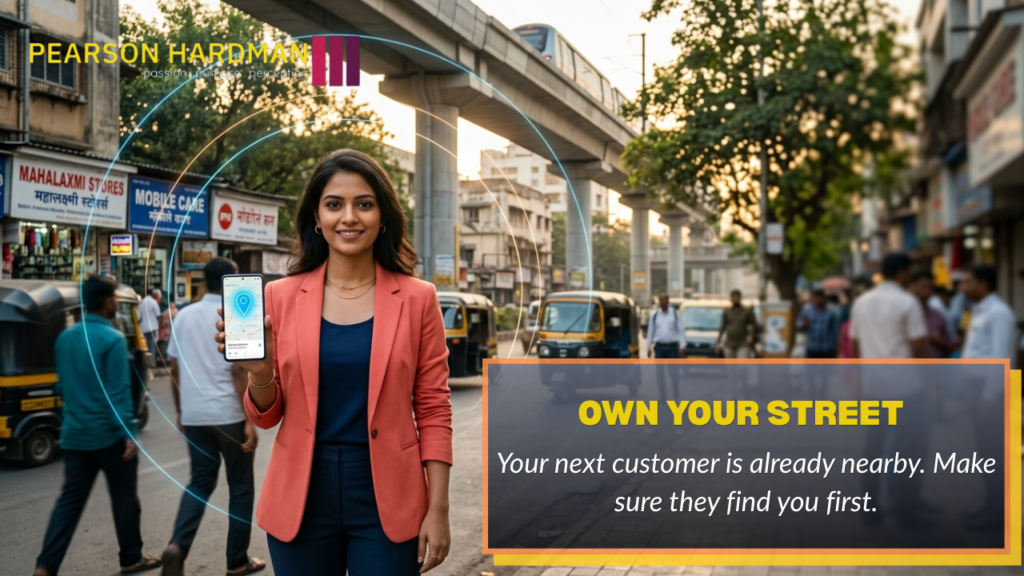
Imagine this. A potential customer walks past your competitor’s store in Thane West, pulls out their phone, and within seconds sees an ad for your brand on Instagram. Not a generic ad. A personalised message that says, “Hey, we’re just 5 minutes away and we have exactly what you’re looking for.” They tap the ad, visit your store, and make a purchase. Your competitor never even knew they were there.
This is not science fiction. This is geo-fencing, and it is quietly becoming one of the most powerful hyper-local targeting strategies available to businesses operating in Mumbai’s rapidly expanding suburban markets. As the city sprawls further into Thane, Navi Mumbai, Andheri, Borivali, Mira Road, and Kalyan, the opportunity for location-based marketing has never been bigger. Yet most business owners are still spending their advertising budgets on broad, city-wide campaigns that reach people who will never visit their outlet, walk into their showroom, or book their service.
In this article, we are going to break down exactly how geo-fencing works, why it is a game-changer for businesses in Mumbai’s suburbs, and how you can use hyper-local targeting to consistently pull customers away from your competition and into your ecosystem. By the time you finish reading, you will have a clear picture of the strategy, the tools, and the mindset required to win in your local market.
What is Geo-Fencing and How Does It Actually Work?
Geo-fencing is a location-based digital marketing technology that allows businesses to draw a virtual boundary, or a “fence,” around a specific geographic area. When a mobile user enters or exits that boundary, they can be triggered to receive a push notification, an in-app advertisement, an SMS, or a social media ad. The technology uses a combination of GPS data, cell tower triangulation, Wi-Fi positioning, and RFID signals to detect a device’s location with remarkable precision.
The process works like this. A business defines a geographic boundary around a specific location, which could be their own store, a competitor’s showroom, a popular mall, a railway station, or even an entire neighbourhood like Powai or Kharghar. When a smartphone user with location services enabled enters that defined area, the geo-fencing software detects the device and adds it to an audience segment. That segment is then used to serve targeted advertisements across platforms like Google, Meta, YouTube, and various ad networks, either in real time or through retargeting campaigns in the hours or days that follow.
What makes this technology particularly powerful is the level of precision it offers. A business in Mulund can literally draw a fence around Phoenix Marketcity in Kurla and serve ads to every shopper who walks through that mall on a Saturday afternoon. A real estate developer in Panvel can target everyone who attends a competitor’s site visit. A restaurant in Bandra can geo-fence Worli and Juhu to pull in residents who are actively looking for dining options on a Friday evening. The possibilities are as creative as your marketing strategy allows.
Why Mumbai’s Suburbs Are the Perfect Market for Hyper-Local Targeting
Mumbai is not one city. It is a collection of distinct micro-markets, each with its own culture, income profile, commuting behaviour, and consumer psychology. Borivali residents behave differently from Andheri consumers. Thane has a distinct identity separate from Navi Mumbai. A marketing campaign that works in Dadar will not automatically resonate in Dombivli. Understanding this fragmentation is the first step to winning the suburban market, and geo-fencing is the technology that makes this understanding actionable.
The suburban population of Mumbai is growing at a pace that most marketers are underestimating. Thane district alone added millions of residents in the last decade as affordable housing projects, metro connectivity, and infrastructure development made it an attractive destination for working professionals and growing families. Similarly, Navi Mumbai has evolved from a planned satellite city into a self-sufficient economic hub with its own malls, hospitals, schools, IT parks, and entertainment zones. These are high-intent consumers with disposable income and very specific local needs. They are not driving to South Mumbai for a haircut, a gym membership, or a weekend meal. They are buying local, and the businesses that market locally win their loyalty.
This behavioural pattern creates an enormous opportunity for geo-fencing. When consumers are physically present in their own suburb, they are most likely to make a purchase decision that benefits a local business. Hyper-local targeting through geo-fencing means your brand appears at exactly the right moment, in exactly the right place, to exactly the right person. No other digital marketing strategy delivers this level of contextual relevance at this cost efficiency.
The Business Case for Geo-Fencing in Mumbai’s Competitive Market
Let us be honest about something. Mumbai is one of the most competitive consumer markets in India. Whether you are running a real estate business in Navi Mumbai, a multi-brand fashion outlet in Malad, a co-working space in Andheri East, an educational institute in Borivali, or a dental clinic in Thane, you are competing for the attention of a time-poor, digitally active consumer who sees hundreds of ads every single day. Standing out requires more than a good product. It requires being seen at the right moment.
The return on investment from geo-fencing campaigns consistently outperforms broad demographic targeting when applied correctly. Several studies across global markets have shown that location-based mobile advertising generates click-through rates that are two to three times higher than standard display advertising. The reason is simple. When someone is physically near your store or your competitor’s location, they are in a purchase-ready mindset. They are not browsing from their couch on a Sunday morning with no intention to buy. They are out, they are moving, and they are looking. Showing them your ad at that moment dramatically increases the probability of conversion.
For a business in Mumbai’s suburbs, this has a direct impact on cost per acquisition. Instead of spending a large budget to reach an audience of lakhs across the city and converting a fraction of them, geo-fencing allows you to concentrate your spend on the few thousand high-intent consumers in your immediate vicinity. Smaller audience, higher relevance, better results. This is not a theory. This is the measurable reality that smart businesses in cities like Bangalore, Hyderabad, and Delhi have already adopted, and Mumbai’s suburban businesses are just beginning to recognise.
Geo-Fencing vs. Geo-Targeting: Understanding the Difference
Before going deeper, it is worth clarifying a distinction that confuses many business owners and even some marketing professionals. Geo-targeting and geo-fencing are not the same thing, though they are often used interchangeably.
Geo-targeting is the broader practice of delivering content or advertisements to an audience based on their geographic location. For example, when you run a Facebook ad campaign and select “Mumbai” as your target city, that is geo-targeting. It is useful but relatively imprecise. You are reaching millions of people who happen to be somewhere within the city limits, regardless of whether they are near your business or even interested in your category.
Geo-fencing is a subset of geo-targeting, but it operates at a much more granular, real-time level. Instead of targeting an entire city or zip code, you draw a precise perimeter, sometimes as small as 100 metres, around a specific location. The trigger is physical presence within that boundary. This is what makes geo-fencing uniquely powerful for hyper-local targeting. It is the difference between fishing in the entire ocean and fishing in a specific pond where you know the fish are hungry and ready to bite.
For businesses in Mumbai’s suburbs where competition is intensely local, this distinction matters enormously. A gym in Thane West does not need to reach all of Mumbai. It needs to reach the people who walk past its door every morning and evening. A jewellery showroom in Navi Mumbai does not need pan-city awareness. It needs to convert the families who are already visiting the nearby mall on weekends. Geo-fencing is built precisely for this kind of targeted, local, conversion-focused marketing.
How to Set Up a Geo-Fencing Campaign for Your Mumbai Suburban Business
Defining Your Geo-Fence Boundaries Strategically
The first and most critical step is choosing where to draw your fence. Many businesses make the mistake of simply drawing a circle around their own store and calling it a day. While fencing your own location for retargeting walk-in visitors is valuable, the real strategic advantage of geo-fencing comes from competitor conquesting and intent-based audience capture.
Competitor conquesting means drawing a geo-fence around a competitor’s location to capture their audience. If you run a fitness studio in Kandivali and your biggest competitor has a centre nearby, you can geo-fence their location and serve your ads to everyone who visits them. You are not interrupting someone who is relaxing at home. You are reaching someone who is actively interested in fitness and already in the buying process. Your message can be a compelling offer, a free trial, or a comparison that positions your studio as the smarter choice.
Intent-based fencing means drawing boundaries around locations that signal purchase intent relevant to your category. A car dealership in Vashi can fence competing showrooms in Kharghar and Panvel. A children’s play school in Mira Road can fence pediatric clinics and hospitals in the same area, reaching parents who are actively engaged in decisions about their child’s development. A luxury home interiors brand can fence premium housing projects and new-possession societies. The more creative and strategic your fence placement, the higher the relevance of your audience.
Choosing the Right Platforms for Geo-Fenced Advertising
Once your boundaries are defined, you need to choose the platforms through which you will reach your geo-fenced audience. The major channels available in India for geo-fencing campaigns include Google Ads, Meta Ads, programmatic display networks, and several India-specific platforms like InMobi and Times Internet’s ad network.
Google Ads offers location-based targeting that can be layered with radius targeting and audience signals to approximate geo-fencing behaviour. Meta’s location-based ad tools allow you to target people who live in, are currently in, or have recently visited a specific area, which is particularly effective for lifestyle and consumer businesses. Programmatic platforms give you access to a vast inventory of apps and websites where your ads can appear on users’ phones when they are within your defined boundary.
For Mumbai suburban businesses, Meta tends to deliver strong results given the high active user base in Thane, Navi Mumbai, and the Western and Central suburbs. Google Display combined with YouTube pre-roll works well for awareness-led geo-fencing campaigns. The key is to not just pick one channel but to create a coordinated presence so that a user who enters your geo-fence sees your brand across multiple touchpoints within a short span of time.
Crafting the Right Creative for Hyper-Local Audiences
The message matters as much as the targeting. A geo-fencing campaign with generic creative is a missed opportunity. When someone sees your ad because they are physically near your location or your competitor’s location, the ad copy should reflect that local context. Mentioning the locality by name, referencing a landmark, or speaking to a very specific local problem makes your ad feel personal and relevant rather than just another piece of advertising.
A real estate developer in Kharghar targeting residents of competing projects nearby could run an ad that says, “Considering your next upgrade in Navi Mumbai? See why 400 families chose us over everyone else.” A restaurant in Powai targeting the IT park crowd at Hiranandani could run an ad at lunchtime that says, “Skip the cafeteria today. Lunch delivered to Hiranandani Business Park in under 30 minutes.” The specificity is what drives the click. The relevance is what drives the conversion.
Real-World Applications of Geo-Fencing in Mumbai’s Suburban Markets
Retail and Fashion Outlets
A multi-brand retail outlet in Malad’s Infiniti Mall can geo-fence competing malls like Oberoi Mall in Goregaon and Link Square in Andheri. When shoppers walk into these competing spaces, they receive ads promoting an exclusive sale or a loyalty reward at your outlet. The timing of these ads, particularly on weekends and festival seasons like Diwali and Eid, can directly pull footfall from your competition.
Healthcare and Wellness
Clinics, diagnostic centres, gyms, and wellness brands have one of the strongest use cases for geo-fencing. A diagnostic lab in Bhandup can fence nearby hospitals and clinics where patients go for consultations, ensuring that when a patient is referred for blood work or a scan, they see an ad for the closer, more affordable alternative. A yoga studio in Andheri West can fence popular organic cafes and health food stores in the area, reaching health-conscious consumers who are clearly aligned with the wellness category.
Education and Coaching
The education sector in Mumbai’s suburbs is fiercely competitive. Engineering coaching institutes, MBA prep centres, school admission consultancies, and skill development platforms can all benefit enormously from geo-fencing. A coaching class in Dombivli preparing students for JEE can geo-fence school premises during parent-teacher meetings or examination seasons. An MBA admissions consultant can fence CAT examination centres across Mumbai suburbs on the day of the exam, capturing thousands of serious aspirants at the exact moment they are thinking about their next step.
Real Estate and Home Services
Real estate is perhaps the highest-value application of geo-fencing in the Mumbai market. Developers launching new projects in Kalyan, Panvel, or Mira Road can geo-fence existing societies in those areas and serve ads to current residents who might be looking to upgrade. Home services businesses like interior designers, modular kitchen brands, and waterproofing contractors can geo-fence newly developing residential societies where residents are actively setting up their homes.
Common Mistakes to Avoid in Geo-Fencing Campaigns
The first major mistake businesses make is setting their fence too large. Drawing a 10-kilometre radius around your store in Mumbai essentially gives you the same broad targeting as a city-level campaign. For hyper-local targeting to work, your fence needs to be precise, typically between 100 metres and 2 kilometres depending on the context and category.
The second mistake is failing to align the geo-fencing schedule with actual consumer behaviour. Mumbai commuters travel at specific times, shop at specific times, and make decisions at specific times. A gym should geo-fence the nearby train station during the morning rush between 7 and 10 am, when commuters are thinking about their day. A restaurant should activate its geo-fence campaign around lunch between noon and 2 pm and dinner between 7 and 9 pm. Running ads at off-peak hours wastes budget and dilutes the effectiveness of an otherwise strong strategy.
The third mistake is ignoring follow-up retargeting. Geo-fencing is most powerful when it is the beginning of a journey, not a single touchpoint. Once a user is captured in your geo-fence audience, you should have a retargeting sequence in place that continues to nurture them with relevant content, testimonials, offers, and reminders over the following days. The combination of real-time geo-fencing and post-visit retargeting creates a surround-sound marketing effect that significantly increases conversion rates.
Measuring the Success of Your Geo-Fencing Strategy
Like any marketing investment, geo-fencing needs to be measured rigorously. The key metrics to track include click-through rate on geo-fenced ads, cost per click, store visit attribution where available through Google Ads, conversion rate from ad click to inquiry or purchase, and frequency of exposure per unique user.
Most programmatic geo-fencing platforms also offer foot traffic attribution reports, which use anonymised mobile data to show how many users who were served your ad within the geo-fence subsequently visited your physical location. This is an incredibly powerful data point because it connects digital ad spend directly to physical store visits, giving you a clear picture of the real-world impact of your campaign. For Mumbai suburban businesses where footfall is a key business metric, this level of attribution clarity is invaluable.
Conclusion: The Suburbs Are Ready. Is Your Marketing?
Mumbai’s suburban markets are no longer the “B-tier” outskirts of a metro city. They are thriving, competitive, aspirational ecosystems with millions of active consumers who are ready to spend with the brands that show up for them in the right way, at the right time, in the right place. Geo-fencing is the technology that makes this possible. It is not a future marketing tool. It is a present-day competitive advantage that the smartest businesses in your neighbourhood are beginning to deploy.
The question is not whether geo-fencing works. The data across global and Indian markets confirms that it does. The question is whether you are going to use it before your competitor does. Every day you run a generic city-wide campaign while your competitor geo-fences the street outside your store is a day you are losing customers you should have won.
At Pearson Hardman, we specialise in building hyper-local targeting strategies for ambitious businesses in Mumbai and across India’s major metros. We combine deep market understanding, creative strategy, and data-driven execution to ensure that your geo-fencing campaigns do not just run but actually win. If you are ready to stop broadcasting to everyone and start converting the people who are already looking for exactly what you offer, it is time to have a conversation.
The suburbs are ready. The only question is whether your marketing is.