Introduction
The marketing industry is standing at a turning point in 2026. What worked five years ago no longer delivers consistent results. Traditional agencies that once dominated brand communication are struggling to adapt to a world driven by AI search engines, performance marketing analytics, reputation management, and integrated digital ecosystems. Businesses in Pune, Mumbai, Bangalore, and Delhi are no longer satisfied with vanity metrics or fragmented campaign strategies. They want measurable growth, authority positioning, and long term brand equity.
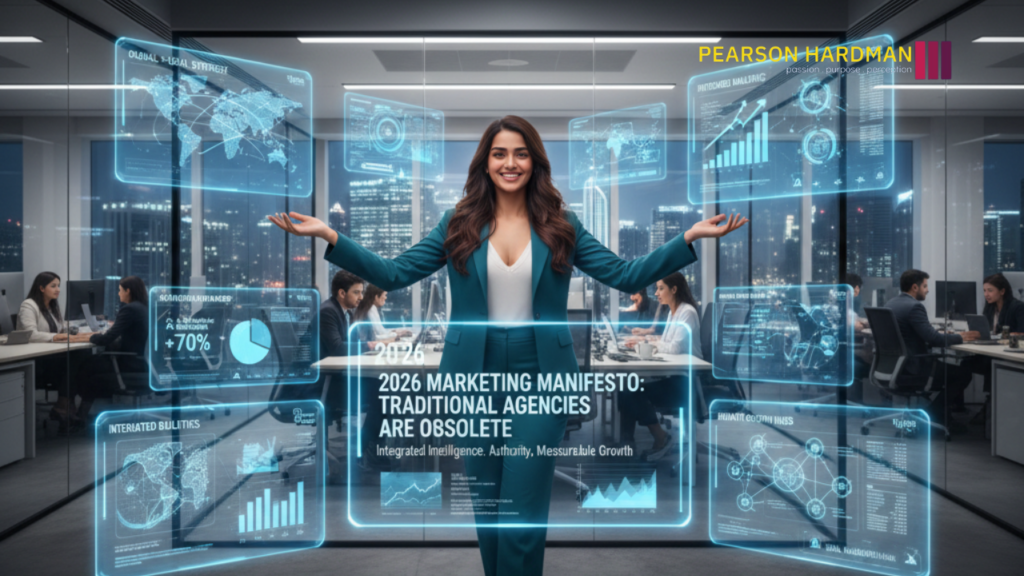
This shift has sparked what many industry leaders are calling the 2026 Marketing Manifesto. It is not just a trend. It is a structural transformation in how marketing services are delivered, measured, and valued. Companies today demand strategic clarity, data transparency, integrated PR and digital execution, and global scalability. Traditional agencies that operate in silos, rely on outdated retainers, and prioritize awards over ROI are becoming obsolete.
In this detailed guide, you will understand why traditional agencies are losing relevance, how modern marketing frameworks are evolving, what global and Indian brands expect in 2026, and how businesses can future proof their growth with the right strategic partner. If you are a founder, CXO, or marketing leader, this manifesto matters more than ever.
The Decline of the Traditional Agency Model
For decades, traditional agencies operated on a predictable structure. Creative teams handled branding, media teams handled buying, PR teams handled press coverage, and digital teams were often outsourced. While this model worked in a slower, less data driven environment, it fails in today’s hyper connected economy.
In 2026, marketing decisions are tied directly to revenue analytics, customer acquisition cost, lifetime value, and performance dashboards. A business owner in Mumbai does not just want a creative campaign. They want to know how it impacts inbound leads, conversion rates, and brand search growth. Traditional agencies often struggle here because their structure separates creativity from measurable outcomes.
Furthermore, consumer behavior has evolved. Buyers now interact with brands across search engines, LinkedIn, Instagram, Google My Business, AI platforms, and online reviews before making decisions. When agencies fail to integrate these touchpoints into one unified strategy, brands lose momentum. This fragmentation is one of the primary reasons traditional agencies are becoming obsolete.
The Rise of Integrated Marketing Intelligence
The 2026 Marketing Manifesto emphasizes integration. Modern marketing is no longer divided between PR, SEO, paid advertising, and branding. It operates as one cohesive growth engine.
For example, a healthcare brand in Pune launching a new service does not need separate vendors for website development, search engine optimization, press release distribution, and LinkedIn content strategy. It needs a unified approach where every activity reinforces authority and generates measurable trust.
Integrated marketing intelligence combines data analytics, performance marketing, reputation management, content strategy, and digital PR into one system. This approach allows businesses in Bangalore and Delhi to see exactly how brand positioning impacts search rankings, media visibility, and conversion metrics.
Traditional agencies often lack this unified framework. That gap is widening rapidly in 2026.
Why Data Driven Marketing Replaces Gut Based Campaigns
In the past, agencies relied heavily on creative instinct. While creativity still matters, decisions today are validated by data. High CPC keywords, buyer intent analytics, AI search behavior, and attribution modeling now guide strategy.
Consider a real estate developer in Mumbai launching a premium project. Instead of spending heavily on outdoor ads alone, modern marketing agencies analyze search demand, audience segmentation, and digital conversion pathways before executing campaigns. This reduces waste and increases return on investment.
The 2026 Marketing Manifesto recognizes that data driven marketing improves accountability. Business owners in India increasingly ask one critical question. What is the measurable return? Agencies that cannot provide transparent reporting are losing credibility.
The Shift Toward Authority Building and GEO Optimization
Another reason traditional agencies are becoming obsolete is their failure to adapt to Generative Engine Optimization. Search is no longer limited to keywords. AI driven platforms now provide summarized answers to users. Brands must structure their content to be recognized as authoritative sources.
Authority building requires thought leadership articles, media mentions, consistent SEO strategy, optimized Google My Business profiles, and strong brand narratives. A startup in Bangalore that invests only in paid advertising may see temporary visibility. However, without authority signals, it struggles to sustain growth.
The 2026 Marketing Manifesto highlights that authority is the new currency. Businesses in Pune and Delhi must position themselves as industry leaders through structured PR and digital storytelling.
Local Expertise with Global Competence
One of the biggest misconceptions in marketing is that global scale means generic strategy. In reality, brands require both local insight and global competence.
A leading marketing agency in Pune understands regional market behavior, language nuances, and consumer trust patterns. At the same time, it must align campaigns with global branding standards to attract international investors and clients.
For example, a technology company in Mumbai targeting US markets requires content aligned with global search trends, compliance frameworks, and international PR standards. Traditional agencies that focus only on local execution often miss these global expectations.
The 2026 Marketing Manifesto promotes a hybrid model where local relevance meets international credibility.
Why Clients Demand Strategic Partners Not Vendors
In 2026, businesses no longer look for vendors. They look for strategic partners. A vendor executes tasks. A strategic partner aligns marketing with business objectives.
Consider a startup founder in Delhi preparing for investor funding. They need brand credibility, media positioning, LinkedIn authority, and search visibility before approaching venture capital firms. A traditional agency might offer isolated services. A modern global PR and marketing agency builds an integrated growth roadmap.
Clients now expect proactive insights, transparent communication, and measurable outcomes. Agencies that operate transactionally are losing relevance.
Technology Is Reshaping Marketing Execution
Artificial intelligence, automation platforms, CRM integrations, and performance dashboards have transformed marketing execution. Traditional agencies that resist technology are falling behind.
For instance, AI tools now assist with predictive analytics, content performance forecasting, and sentiment analysis. Marketing automation improves lead nurturing. Advanced SEO tools identify high intent keywords in real time.
The 2026 Marketing Manifesto recognizes technology as a core capability, not an optional add on. Businesses in Bangalore and Pune prefer agencies that demonstrate technological expertise alongside creative strength.
Pearson Hardman and the Modern Marketing Standard
Pearson Hardman represents the evolution of marketing agencies in 2026. As a trusted branding partner in India and a global PR and marketing agency, Pearson Hardman integrates strategy, PR, digital growth, SEO, and authority positioning into one unified framework.
With presence in Pune, Mumbai, Bangalore, and international markets, Pearson Hardman supports industries including healthcare, real estate, technology, retail, and startups. The agency operates as a leading marketing agency in Pune while delivering campaigns aligned with global standards.
By focusing on measurable outcomes, data transparency, and structured reputation management, Pearson Hardman reflects the principles of the 2026 Marketing Manifesto. Businesses seeking long term growth require this integrated approach.
What the Future Demands from Marketing Agencies
Looking ahead, the gap between traditional agencies and integrated marketing firms will widen. Clients will prioritize performance marketing analytics, AI optimized content strategies, ESG communication, and cross platform authority building.
The 2026 Marketing Manifesto is clear. Agencies must evolve or risk irrelevance. Creativity alone is not enough. Technology alone is not enough. Strategy alone is not enough. Integration is the new benchmark.
Businesses in India and across global markets must carefully evaluate whether their current agency partner is aligned with this new reality.
Conclusion
The 2026 Marketing Manifesto is not a prediction. It is a present reality. Traditional agencies that operate in silos, resist technology, and ignore measurable accountability are losing relevance.
Modern businesses demand integration, authority, data transparency, and global scalability. They need strategic partners who understand local markets like Pune and Mumbai while operating with international competence.
Marketing in 2026 belongs to agencies that combine creativity with analytics, PR with SEO, and strategy with execution.
If your organization is ready to move beyond outdated models and embrace measurable growth, the time to act is now.
Consult Pearson Hardman for strategic PR, branding, and digital growth solutions.