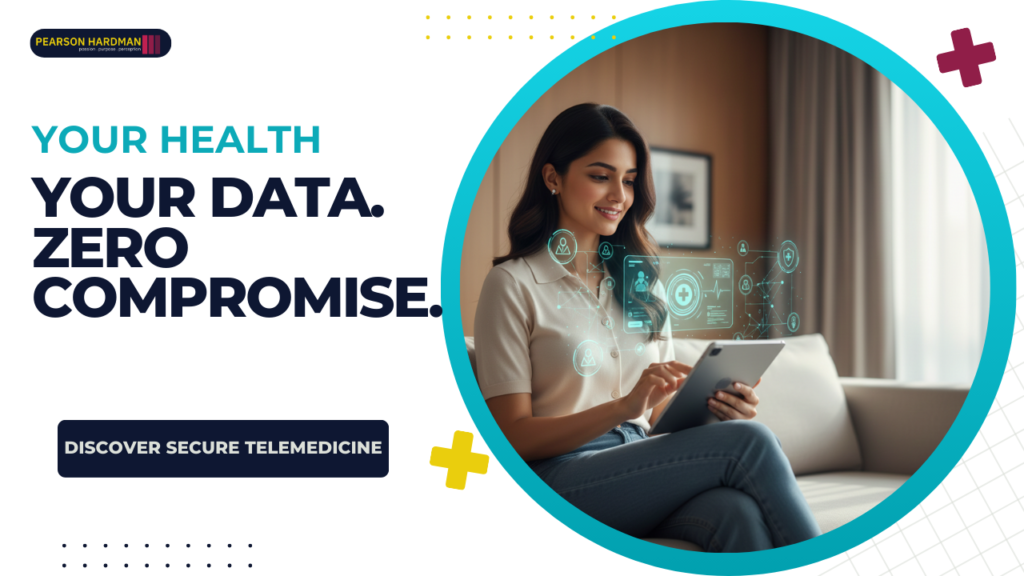
Imagine a patient named Anjali in early 2026 who needs to consult a world-class oncologist halfway across the country. She is rightfully anxious about her diagnosis, but she is equally terrified by the recent headlines reporting yet another massive healthcare data breach that exposed millions of private medical records to the dark web. Anjali wants the convenience of a video consultation, yet she hesitates to upload her sensitive history to a cloud server she does not fully control. This “Privacy Paradox” is the single greatest hurdle facing the digital health industry today. As we navigate the complexities of Telemedicine 2026, the traditional methods of simply claiming “HIPAA compliance” are no longer sufficient to convert a skeptical lead into a loyal patient. At Pearson Hardman, we recognize that the future of healthcare marketing lies in a revolutionary concept known as Zero-Knowledge PR, which uses advanced cryptography as a cornerstone for building unbreakable brand equity.
The shift we are witnessing is moving away from a model of “Trust us with your data” toward a model of “We cannot see your data, even if we wanted to.” This is made possible by Zero-Knowledge Proofs (ZKP), a cryptographic method that allows one party to prove to another that a statement is true without revealing any information beyond the validity of the statement itself. In this comprehensive guide, we will explore how your agency or healthcare brand can leverage Telemedicine 2026: Winning Patient Trust with Zero-Knowledge PR to dominate the market. You will learn the mechanics of this privacy-first technology, why it is the new gold standard for medical marketing, and how to communicate these complex technical benefits into a narrative that resonates with the average patient. By the end of this article, you will understand how to transform security from a hidden back-end requirement into your most visible and profitable marketing asset.
The Evolution of Patient Skepticism and the 2026 Trust Gap
To understand why Telemedicine 2026: Winning Patient Trust with Zero-Knowledge PR is so critical, we must look at the wreckage of the previous years’ digital health landscape. By 2024 and 2025, the novelty of “seeing a doctor on your phone” had worn off, replaced by a growing awareness of digital vulnerability. Patients realized that their most intimate data—biometric scans, genetic predispositions, and mental health notes—were being stored in centralized silos that acted as magnets for cybercriminals. Consequently, the public’s willingness to share data with even legitimate clinicians began to drop. The “Convenience vs. Privacy” trade-off reached a breaking point, and patients started demanding “Digital Sovereignty,” where they own their data and only grant temporary, cryptographic access when absolutely necessary.
This trust gap has created a bifurcated market where “Legacy Telemedicine” platforms are struggling with high customer acquisition costs because they cannot overcome the inherent fear of data leaks. On the other hand, “Privacy-First” platforms are seeing exponential growth by treating security as a lifestyle benefit rather than a legal box to check. At Pearson Hardman, we believe that the marketing of these services must move beyond the technical jargon of the IT department and into the realm of human-centric storytelling. We help our clients explain that their platform uses “Invisible Shields” that allow a doctor to verify a patient’s insurance or identity without ever seeing their Social Security number or full medical history unless explicitly authorized. This is the heart of winning trust in the new age of remote care.
Decoding the Cryptography: How Zero-Knowledge PR Works
The term “Zero-Knowledge” sounds like a paradox in a field like PR, where the goal is usually to share information. However, Telemedicine 2026: Winning Patient Trust with Zero-Knowledge PR refers to the strategic communication of “Proof without Exposure.” Think of it like a bouncer at a club who needs to verify you are over 21. Traditionally, you show your ID, and the bouncer sees your birth date, your full name, your home address, and your height. In a Zero-Knowledge world, you would simply show a digital proof that says “Verified: Over 21” without revealing any of the other details. In telemedicine, this means a patient can prove they have a certain condition or a valid prescription to a specialist without the specialist’s platform ever having to store the raw, sensitive documentation in its own vulnerable database.
Furthermore, implementing this technology allows a brand to launch PR campaigns that are fundamentally different from anything seen before. Instead of promising to “protect” data, a brand can truthfully claim that they “never possess” the data in a readable format. This eliminates the “liability of knowledge.” When Pearson Hardman designs a PR strategy for a MedTech firm, we emphasize this “Mathematical Guarantee of Privacy.” We move the narrative from “Trust our employees” to “Trust the math.” This shift is incredibly powerful because while human systems can fail and employees can be social-engineered, the laws of cryptography remain absolute. Educating the market on this distinction is the key to positioning your brand as the only safe choice in a sea of vulnerable competitors.
Why HIPAA Compliance is No Longer the Trust Ceiling
For decades, healthcare marketers have used “HIPAA Compliant” as a catch-all phrase to signal safety. However, by 2026, the sophisticated consumer knows that HIPAA is merely a legal floor, not a security ceiling. HIPAA tells you what you should do with data once you have it, but it does nothing to prevent the inherent risks of centralized data storage. A bank can be fully compliant with every regulation and still be robbed if it keeps all its gold in one visible vault. Zero-Knowledge PR takes the conversation a step further by introducing the concept of “Decentralized Verification.” It suggests that the safest way to handle sensitive data is to never have it in the first place, or at least, never have it in a form that can be compromised.
Moreover, the regulatory landscape is shifting toward much stricter definitions of “Data Minimization” and “Purpose Limitation.” Brands that proactively adopt Zero-Knowledge protocols are finding themselves ahead of the curve, avoiding the massive fines and reputational damage that come with the evolving GDPR-style laws in the United States and India. When you market your brand through the lens of Telemedicine 2026: Winning Patient Trust with Zero-Knowledge PR, you are signaling to investors and patients alike that you are a future-proof institution. You are telling the world that you respect the patient’s “Right to be Unknown” except for the specific purpose of the medical consultation. This level of ethical positioning creates a “Brand Halo” that makes price sensitivity less of an issue for high-value patients.
Transforming Technical Privacy into a Premium Brand Feature
One of the greatest challenges in MedTech marketing is making the “Invisible” visible. How do you market a technology that is designed to make data disappear? At Pearson Hardman, we solve this by treating privacy as a “Premium Lifestyle Feature,” similar to how a luxury car brand markets its advanced safety systems. We don’t just talk about the encryption; we talk about the “Peace of Mind” it provides. We use stories of patients who were able to seek mental health support or sensitive reproductive care without the fear of that information ever showing up in a leak or being used by an insurance company to raise their premiums. This is where Telemedicine 2026: Winning Patient Trust with Zero-Knowledge PR becomes a powerful emotional hook.
Consequently, the visual language of telemedicine branding is also changing. We are moving away from the cold, sterile, “hospital-blue” aesthetic and moving toward a warmer, “tech-safe” vibe that emphasizes empowerment. Your website and app should feature “Trust Badges” that explain, in simple language, that your “Data Sovereignty Engine” is active. You might use copy like: “We don’t hold your history; we just help you heal.” This approach turns the patient into the “Hero” of their own health story, with the platform acting as a secure, high-tech facilitator. By framing privacy as a form of “Self-Care,” you align your brand with the broader wellness trends of 2026, making your telemedicine service feel like a natural extension of a healthy, digital lifestyle.
Real-World Case Studies: ZK-PR in Physician and Insurance Verification
To see the practical power of Telemedicine 2026: Winning Patient Trust with Zero-Knowledge PR, let us look at the process of physician credentialing. Traditionally, verifying that a doctor is licensed to practice in a specific state involved a slow, paper-heavy trail that exposed the doctor’s personal credentials to multiple third-party agencies. In 2026, a telemedicine platform using ZKPs can verify a doctor’s license against a national blockchain-based registry in milliseconds. The platform gets a “Verified” signal, but it never has to store the doctor’s sensitive personal identification files. This makes the platform a much more attractive place for top-tier specialists to work, as they know their own professional and personal data is protected from the platform’s potential vulnerabilities.
Similarly, insurance verification—the bane of the American healthcare system—is being revolutionized. Patients can now provide a Zero-Knowledge Proof that they have active coverage for a specific procedure without the doctor’s office ever needing to see the full details of their policy or other unrelated claims history. This “Selective Disclosure” is a major selling point. Imagine a social media ad that says: “Get verified for your surgery in seconds, without sharing your whole life story.” This is a high-converting message because it addresses a specific, recurring pain point with a futuristic solution. Pearson Hardman specializes in identifying these “Friction Points” and applying a Zero-Knowledge PR narrative to smooth them over, leading to higher enrollment and lower churn rates for our MedTech clients.
Conclusion: The New Frontier of Healthcare Sovereignty
The landscape of Telemedicine 2026: Winning Patient Trust with Zero-Knowledge PR is not just about adopting a new piece of software; it is about adopting a new philosophy of human respect. We are moving toward a “Post-Data-Hoarding” world where the most successful companies are the ones that take the least from their users while providing the most value. By integrating Zero-Knowledge Proofs into your branding and PR strategy, you are not just selling a medical service—you are selling a sanctuary. You are offering a place where a patient can be their most vulnerable self, knowing that their digital identity remains untouchable and their secrets remain their own.
At Pearson Hardman, we are ready to help you navigate this complex cryptographic and communicative shift. Whether you are a startup looking to disrupt the healthcare space or an established hospital system looking to modernize your digital trust, the path forward is clear. It is time to stop asking for the patient’s trust and start proving that you have earned it through the power of Zero-Knowledge technology. The future of healthcare is private, it is secure, and it is built on the silent, powerful foundation of the Zero-Knowledge Proof. Are you ready to lead the revolution?