Introduction
Across farms worldwide, one challenge keeps resurfacing in conversations with growers, agribusiness owners, and agri-tech marketers alike. Labor is becoming scarce, expensive, and unpredictable. Seasonal workers are harder to find, skilled farmhands are aging out, and younger generations are moving away from traditional agriculture roles. At the same time, food demand is rising, water resources are shrinking, and margins are tighter than ever. This is where Smart Irrigation & Drones enter the picture, not just as innovative tools, but as powerful labor solutions that are reshaping how modern agriculture operates and how it should be marketed.
Smart Irrigation & Drones are no longer futuristic concepts discussed only at agri expos or technology summits. They are practical, field-tested systems that help farmers do more with fewer people. From automated water scheduling to drone-based crop monitoring, these technologies reduce dependency on manual labor while improving yield quality and operational efficiency. In this article, you will learn how Smart Irrigation & Drones function as labor-saving solutions, why they are gaining rapid adoption, and how agri-tech brands can market them effectively to decision-makers who are actively searching for answers to labor shortages.
Understanding the Agricultural Labor Crisis
The agricultural labor crisis did not appear overnight. It has been building quietly for decades, driven by urban migration, changing demographics, rising wages, and stricter labor regulations. Farmers today often struggle to find reliable workers during critical periods such as planting, irrigation setup, pest control, and harvest preparation. Even when labor is available, the cost of managing large teams eats into profitability and adds operational stress.
In many regions, a single missed irrigation cycle or delayed pest inspection can lead to yield losses that outweigh the cost of technology investments. This reality has pushed growers to look beyond traditional solutions. Smart Irrigation & Drones offer a way to replace repetitive, time-consuming tasks with automated, data-driven systems that work consistently without fatigue or human error. Understanding this pain point is essential for anyone marketing agri technology, because the labor problem is the emotional and financial trigger behind most buying decisions in this space.
What Is Smart Irrigation and Why It Matters
Smart irrigation refers to advanced irrigation systems that use sensors, weather data, soil moisture analysis, and automation to deliver water precisely when and where crops need it. Unlike traditional irrigation methods that rely on fixed schedules or manual judgment, smart irrigation systems adjust in real time based on actual field conditions. This not only conserves water but also significantly reduces the need for human intervention.
For a farmer managing hundreds of acres, manually checking soil moisture, adjusting valves, and monitoring water flow can require a dedicated team. Smart Irrigation & Drones eliminate much of this workload. Automated controllers, IoT-enabled valves, and mobile dashboards allow a single operator to manage irrigation across vast areas. From a labor perspective, this translates into fewer workers, fewer errors, and more predictable outcomes.
How Smart Irrigation Replaces Manual Labor
The labor-saving impact of smart irrigation becomes clear when you look at day-to-day farm operations. Traditionally, irrigation involved physical inspection of fields, manual pump operation, and constant supervision. Workers had to be present early mornings or late nights to manage water schedules, often under challenging conditions.
With Smart Irrigation & Drones integrated into farm systems, irrigation becomes largely autonomous. Soil sensors communicate directly with control units, which activate or shut off irrigation zones automatically. Alerts are sent to smartphones if anomalies occur, reducing the need for physical patrols. Over time, farmers report not only labor savings but also improved crop consistency and reduced stress. For marketing teams, highlighting these real-world labor savings resonates far more than generic efficiency claims.
The Role of Drones in Modern Farming
Drones have transformed from hobbyist gadgets into essential agricultural tools. In farming, drones are used for crop scouting, plant health analysis, irrigation assessment, pest detection, and even spraying in some regions. The true value of drones lies in their ability to cover large areas quickly and provide actionable data that would otherwise require hours of manual labor.
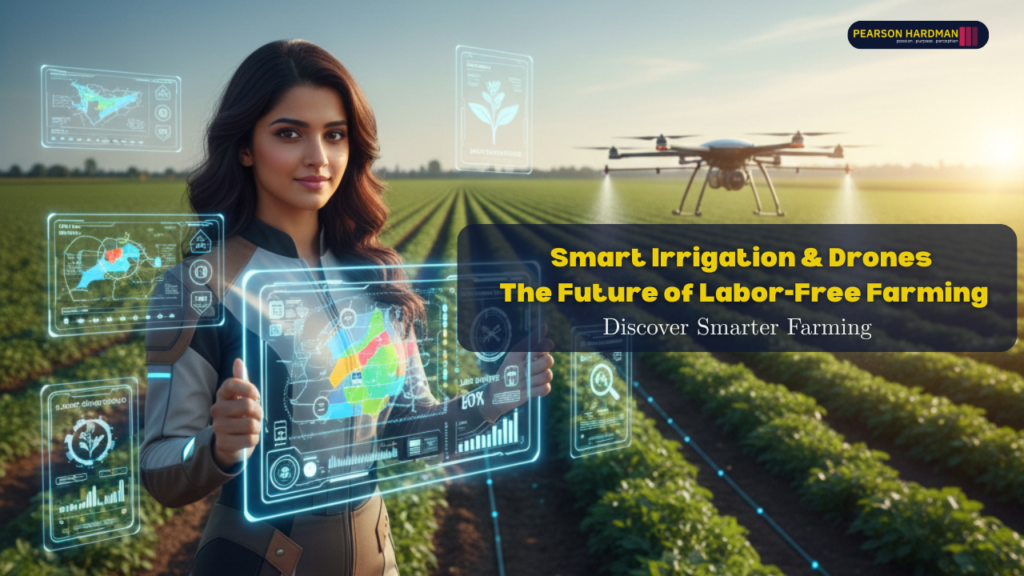
When paired with smart irrigation systems, drones become even more powerful. A drone can identify dry zones, clogged emitters, or uneven water distribution in minutes. This data feeds directly into smart irrigation platforms, enabling targeted adjustments without sending workers into the field. Smart Irrigation & Drones together create a closed-loop system where monitoring and action happen seamlessly, with minimal human involvement.
Drones as a Solution to Skilled Labor Shortages
One of the most overlooked benefits of drones is their ability to reduce reliance on highly skilled field workers. Identifying early signs of crop stress, disease, or irrigation failure traditionally required experienced agronomists or seasoned farmhands. Today, drones equipped with multispectral cameras and AI analytics can detect these issues automatically.
A single drone operator can replace multiple field inspectors, especially on large farms. Even better, many drone platforms are designed for ease of use, allowing farm owners or managers to operate them without extensive technical training. For marketers, positioning Smart Irrigation & Drones as tools that democratize expertise can be a powerful message, especially for mid-sized farms struggling to retain skilled labor.
Smart Irrigation & Drones as a Unified System
Individually, smart irrigation and drones are valuable. Together, they form a comprehensive labor-saving ecosystem. Drones provide aerial insights that guide irrigation decisions, while smart irrigation systems execute those decisions automatically. This integration minimizes manual coordination and reduces delays caused by human dependency.
Imagine a vineyard where a drone flight identifies moisture stress in specific rows. The smart irrigation system receives this data and adjusts water delivery precisely in those zones. No workers need to walk the rows, no guesswork is involved, and no time is wasted. This is not a future scenario; it is already happening on farms that have embraced Smart Irrigation & Drones as a unified solution.
Marketing Smart Irrigation & Drones as a Labor Solution
For agri-tech companies, the biggest mistake in marketing Smart Irrigation & Drones is focusing solely on features. Farmers do not buy sensors, drones, or dashboards for their technical elegance. They buy solutions to pressing problems. Labor shortage is one of the most urgent and emotionally charged problems in agriculture today.
Effective marketing should frame Smart Irrigation & Drones as reliable workers that never call in sick, never demand overtime, and never lose focus. Case studies that show reduced labor costs, fewer field visits, and improved operational control are far more persuasive than technical specifications. Storytelling plays a critical role here, especially when it reflects real farming challenges and tangible outcomes.
Real World Example of Labor Transformation
Consider a mid-sized vegetable farm in western India that struggled every season to hire irrigation staff. Manual irrigation checks consumed hours each day, and inconsistent watering affected crop quality. After installing a smart irrigation system and using drones for weekly field analysis, the farm reduced its irrigation labor needs by nearly 60 percent within one season.
The owner no longer needed multiple workers for routine checks. Instead, one supervisor monitored everything from a mobile app. The savings were reinvested into expanding acreage, proving that Smart Irrigation & Drones do not just reduce costs, they unlock growth. Stories like this should be central to any marketing strategy targeting practical, ROI-focused buyers.
Data, Trust, and EEAT in Agri-Tech Marketing
In 2025, Google’s EEAT principles play a crucial role in content performance. Expertise, experience, authority, and trust are especially important in agriculture, where buying decisions carry high financial risk. Content about Smart Irrigation & Drones must demonstrate real understanding of farming realities, not just surface-level technology trends.
Including expert insights, farmer testimonials, and data-backed claims builds credibility. Avoid exaggerated promises and instead focus on measurable benefits such as reduced labor hours, improved water efficiency, and consistent yields. This approach not only satisfies search engines but also builds genuine trust with readers who are evaluating solutions for their livelihoods.
The Economic Impact of Reduced Labor Dependency
Reducing labor dependency has a ripple effect across farm economics. Lower wage bills, fewer recruitment challenges, and reduced training costs all contribute to stronger financial stability. Smart Irrigation & Drones also reduce the risk of human error, which can lead to costly mistakes such as overwatering or missed pest outbreaks.
From a long-term perspective, farms that adopt automation become more resilient to external shocks such as labor strikes, migration shifts, or policy changes. This resilience is a compelling value proposition for investors, lenders, and partners, making Smart Irrigation & Drones attractive beyond day-to-day operations.
Overcoming Adoption Barriers Through Education
Despite their benefits, some farmers remain hesitant to adopt Smart Irrigation & Drones due to perceived complexity or cost. This is where education-focused marketing becomes essential. Clear explanations, onboarding support, and transparent ROI calculations help overcome resistance.
Content that walks readers through implementation steps, maintenance requirements, and learning curves reduces fear and builds confidence. When farmers understand that these systems are designed to simplify their work, not complicate it, adoption rates increase significantly.
The Role of Government and Subsidies
In many regions, governments are actively promoting smart irrigation and drone usage through subsidies and pilot programs. These initiatives are often driven by water conservation goals and labor efficiency targets. Marketing content that highlights available incentives and compliance benefits can significantly boost conversion rates.
Smart Irrigation & Drones are increasingly aligned with sustainability goals, making them eligible for grants and tax benefits. Educating farmers about these opportunities adds another layer of value and positions brands as helpful partners rather than aggressive sellers.
Future Outlook for Smart Irrigation & Drones
The future of agriculture is undeniably automated. As AI, machine learning, and remote sensing technologies evolve, Smart Irrigation & Drones will become even more autonomous and interconnected. Predictive irrigation models, real-time pest alerts, and self-optimizing systems are already in development.
For marketers, staying ahead of these trends means continuously updating content, sharing insights, and positioning products as future-ready solutions. Farmers want investments that will remain relevant for years, not tools that become obsolete quickly. Highlighting scalability and software updates can address these concerns effectively.
Conclusion
The agricultural labor crisis is not a temporary challenge, it is a structural shift that demands new solutions. Smart Irrigation & Drones offer a practical, proven way to reduce labor dependency while improving efficiency, sustainability, and profitability. For farmers, they represent freedom from constant manual oversight. For agri-tech brands, they represent an opportunity to market technology as a dependable workforce replacement.
As adoption accelerates, the conversation will move from innovation to necessity. Those who understand how to position Smart Irrigation & Drones as true labor solutions will lead the next chapter of modern agriculture. The question is no longer whether farms can afford this technology, but whether they can afford to operate without it.