Imagine scrolling through your phone late at night and stumbling upon a fifteen-second clip of golden, crispy dosas sizzling on a tawa somewhere in Bangalore, or a slow-motion pour of rich Parisian hot chocolate into a ceramic mug. Before you know it, you are not just hungry but genuinely curious about the place, the people, and the story behind that dish. This is the quiet power of culinary tourism in the age of short-form video, and it is reshaping how millions of people around the world choose their travel destinations.
The global travel landscape has shifted dramatically over the past few years. Travelers today are not just looking for beaches or monuments. They want experiences that feel personal, cultural, and deeply authentic. Food has always been at the heart of culture, but short-form video platforms like Instagram Reels, YouTube Shorts, and TikTok have transformed local cuisine into a globally marketed product. A single viral street food video from a small alley in Pune or a ramen stall in Tokyo can generate thousands of bookings and trigger an entire wave of food tourism in that region.
In this article, you will explore how culinary tourism works in the digital age, why short-form video has become its most powerful sales tool, how brands and destinations are leveraging this trend, and what agencies like Pearson Hardman are doing to help clients ride this wave successfully across India and around the world.
What Is Culinary Tourism and Why It Matters in 2026
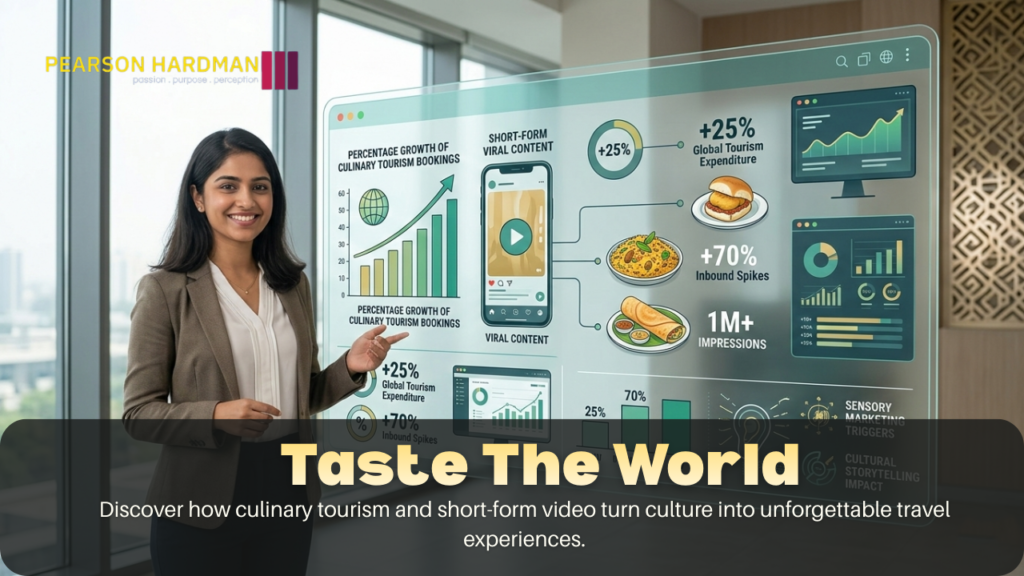
Culinary tourism, at its core, is the act of traveling to experience the food and drink of a specific region or culture. It goes beyond simply eating local food on a trip. It includes visiting local markets, attending cooking classes, meeting farmers and chefs, exploring food histories, and understanding the deep cultural roots behind every recipe. According to the World Food Travel Association, culinary tourism now accounts for over 25 percent of global tourism expenditure, making it one of the fastest-growing segments in the entire travel industry.
What makes culinary tourism especially powerful in 2026 is the way it intersects with identity and storytelling. Food is deeply personal. When someone sees a video of their ancestral cuisine being prepared in a faraway land, or discovers a dish that reminds them of their grandmother’s kitchen, an emotional connection is made instantly. This emotional connection is what drives decisions. People do not just want to visit a destination. They want to feel something, and food is one of the most reliable triggers of that feeling.
India, in particular, sits at a goldmine of culinary diversity. From the coastal seafood curries of Kerala to the robust Rajasthani dal baati churma, from the street-side vada pav in Mumbai to the pav bhaji stalls near Marine Drive, every city and every lane has a story to tell through food. Cities like Pune, Bangalore, Delhi, and Hyderabad have emerged as serious culinary tourism hubs, drawing both domestic and international visitors who want to explore regional food cultures beyond what any guidebook can describe.
Also Read: Employer Branding 2026: Hiring Top Talent Through Social Proof
The Rise of Short-Form Video in Travel and Food Marketing
Short-form video has completely rewritten the rules of content marketing, and nowhere is this more evident than in travel and food. A decade ago, a destination would rely on printed brochures, travel magazines, and television documentaries to attract tourists. Today, a single creator with a smartphone and a nose for flavor can put a local restaurant on the global map in under forty-eight hours. That is not an exaggeration. It is a reality that restaurant owners, tourism boards, and marketing agencies are waking up to every single day.
Platforms like Instagram and TikTok have mastered the art of capturing attention within the first three seconds of a video. The algorithms on these platforms actively reward content that drives emotional responses, saves, shares, and comments. Food content naturally triggers all of these behaviors. A perfectly filmed burst of a biryani lid being lifted to release steam, or the moment cheese pulls from a wood-fired pizza in Naples, generates an almost involuntary reaction in viewers. They stop scrolling. They watch again. They tag a friend. And sometimes, they book a flight.
Why Food Content Performs So Well on Social Platforms
The psychology behind food content’s performance is rooted in something called sensory marketing. Even though viewers cannot smell or taste what they see on screen, their brains simulate the experience based on visual and audio cues. The sizzle of a pan, the crunch of a fresh salad, the steam rising off a cup of masala chai, these are sensory triggers that short-form video captures beautifully. Creators who understand this produce content that is not just informative but genuinely immersive.
Beyond sensory appeal, food content carries an inherent story. Every dish has a history, a geography, a community behind it. When a food creator in Pune talks about the origins of misal pav while filming its preparation at a 70-year-old family-run eatery, they are not just making a food video. They are creating a micro-documentary that educates, entertains, and inspires travel intent at the same time. This is the kind of content that global travel and tourism brands are now paying serious money to develop and distribute.
How Destinations Use Short-Form Video to Drive Culinary Tourism
Tourism boards across the world have recognized that short-form video is no longer optional. It is the primary channel through which younger travelers discover destinations. The Indian government’s Incredible India campaign has progressively shifted budget toward digital content, and regional tourism bodies in states like Goa, Rajasthan, and Tamil Nadu have actively partnered with food creators to showcase regional cuisine as a key travel draw. The results have been measurable and impressive.
Thailand’s tourism authority, for instance, ran a campaign specifically around street food culture in Bangkok and Chiang Mai, partnering with micro-influencers who specialize in food travel content. The campaign generated millions of views organically, led to a measurable spike in inbound tourism from South Asian markets, and positioned Thailand’s street food scene as a bucket list experience for a new generation of travelers. Similar strategies are now being replicated in Vietnam, Japan, Portugal, and Mexico, all countries with incredibly rich food cultures that translate beautifully to short-form video.
The Role of Micro-Influencers in Culinary Travel Campaigns
One of the most important shifts in culinary tourism marketing over the past few years is the growing reliance on micro-influencers rather than celebrity endorsements. A micro-influencer with 50,000 highly engaged followers who specifically cover food travel content is far more valuable to a destination or restaurant than a Bollywood celebrity with five million generic followers. The engagement rates are higher, the trust is deeper, and the audience is already primed to take action based on recommendations.
Leading marketing agencies, including trusted branding partners in India like Pearson Hardman, have built entire frameworks around identifying, briefing, and managing micro-influencer campaigns for culinary tourism clients. The approach involves matching the right creator to the right destination, ensuring content authenticity, and building a content calendar that drives sustained visibility rather than a one-time viral spike. This kind of strategic thinking is what separates effective culinary tourism marketing from random content creation.
Culinary Tourism Marketing Strategies for Brands and Restaurants
If you are a restaurant owner, a hospitality brand, a food product company, or a regional tourism authority, the question is no longer whether to invest in culinary tourism marketing but how to do it well. The good news is that the barrier to entry has never been lower. A smartphone, good lighting, and a compelling story are all you technically need to get started. The challenge lies in doing it consistently, strategically, and in a way that actually converts viewers into visitors or customers.
Content strategy for culinary tourism should begin with a clear understanding of your target audience and their travel motivations. Are you targeting international travelers looking for authentic Indian experiences? Are you speaking to domestic travelers from Mumbai or Delhi who want weekend food getaways near Pune or Bangalore? Are you reaching the Indian diaspora abroad who feel nostalgic for regional flavors? Each of these audiences requires a different content tone, platform strategy, and posting rhythm. Getting this wrong means creating beautiful content that never reaches the right eyes.
Building a Short-Form Video Strategy Around Food Storytelling
The most effective culinary tourism content does not feel like marketing. It feels like discovery. The best creators in this space approach every video as a mini story with a beginning, middle, and end. The beginning hooks you with a visual surprise or a provocative question. The middle delivers the sensory experience and cultural context. The end gives you a reason to act, whether that is saving the video, visiting the place, or following the creator for more. This structure works regardless of whether the video is eight seconds or three minutes long.
Brands that want to succeed in this space need to invest in production quality, but not necessarily in expensive equipment. What matters far more is lighting, framing, and sound design. Natural light during the golden hour makes food look extraordinary. Close-up shots of texture and steam create intimacy. Background sounds of a busy market or a kitchen in full swing add authenticity. These are elements that any creator or in-house marketing team can learn to implement with a bit of guidance and practice.
Global and Local Perspectives: India’s Opportunity in Culinary Tourism
India is uniquely positioned to become one of the world’s top culinary tourism destinations in the next decade. The country’s food diversity is unmatched anywhere on earth. With 28 states each carrying distinct culinary traditions, hundreds of regional ingredients, cooking techniques passed down over centuries, and a growing class of food entrepreneurs reimagining traditional recipes, India has an almost infinite supply of compelling food stories to tell. The challenge has been in packaging and distributing those stories to the right global audiences.
Cities like Pune, Mumbai, and Bangalore have already built strong reputations as food destinations within India. Pune’s vibrant cafe culture, its famous misal pav trail, and its rapidly growing food startup ecosystem make it particularly attractive for both domestic food tourism and international attention. A leading marketing agency in Pune that understands the intersection of digital content, PR, and cultural storytelling is in a powerful position to help local food brands and destinations reach audiences they could never access on their own.
Globally, the Indian food market is experiencing a renaissance. From Michelin-starred Indian restaurants in London and New York to the growing popularity of regional Indian street food across Southeast Asia and the Middle East, there is an appetite for authentic Indian culinary stories like never before. A global PR and marketing agency that can bridge this gap, connecting India’s diverse food culture with international travel audiences through strategic short-form video campaigns, is offering enormous value to its clients.
The Business Case for Investing in Culinary Tourism Content
From a pure return-on-investment perspective, culinary tourism content created around short-form video offers some of the highest organic reach potential of any marketing channel available today. When a video goes viral, even partially, the compounding effect of shares, saves, algorithm amplification, and earned media coverage can generate millions of impressions at a fraction of what traditional advertising would cost. For restaurants, this can mean weeks of fully booked tables. For destinations, it can mean a measurable increase in tourism footfall that sustains itself over months.
The business case is even stronger when you factor in the long-term brand equity that culinary tourism content builds. Unlike a paid advertisement that disappears the moment you stop funding it, a well-produced food video on YouTube or Instagram continues to circulate, attract views, and generate discovery for years. Many restaurants and destinations that went viral on social platforms three or four years ago are still receiving inquiries from people who discovered them through those original videos. This is the kind of evergreen value that smart brands are now actively pursuing through structured content investment.
Also Read: Bootstrapped Growth: Scaling to $1M ARR with AI-First Marketing
Conclusion
Culinary tourism is no longer a niche interest for adventurous foodies. It has become a mainstream travel motivation for millions of people around the world, and short-form video is the rocket fuel powering its growth. The destinations, restaurants, and brands that understand how to tell compelling food stories through video content are the ones winning the attention, the trust, and ultimately the bookings of today’s experience-driven travelers.
India stands at a remarkable intersection of culinary richness and digital opportunity. From the bustling food lanes of Pune and Mumbai to the global stage where Indian cuisine is earning new respect and admiration, the moment to invest in strategic culinary tourism marketing has never been better. The brands that act now, with clear strategy, authentic storytelling, and smart distribution, will build an advantage that compounds over time.
If you are ready to position your brand, restaurant, destination, or food business as a leader in the culinary tourism space, Pearson Hardman offers the strategic PR, branding, and digital growth solutions you need. As a trusted branding partner in India with global PR and marketing capabilities, Pearson Hardman helps clients in Pune, Mumbai, Bangalore, Delhi, and across international markets craft content strategies that drive real business results. Consult Pearson Hardman today and let your food story reach the audience it deserves.